Customer context, from checkout to texting.
Dispensary POS customer management connects a shopper’s identity with store visits, purchases, preferences and rewards. That context can help staff serve the person and plan relevant follow-up. A customer record is not a marketing-text subscription; matching the right person and checking current messaging eligibility are separate steps.
In production in 11 states. Nevada, Ohio, and Colorado are expected in January 2027. See supported states.
Customer workspace preview
A useful starting point for the next visit.
Explore sample customer groups, preferences and visit context. The working demo illustrates the workspace; live history, rewards and connected messaging are confirmed for the California deployment.
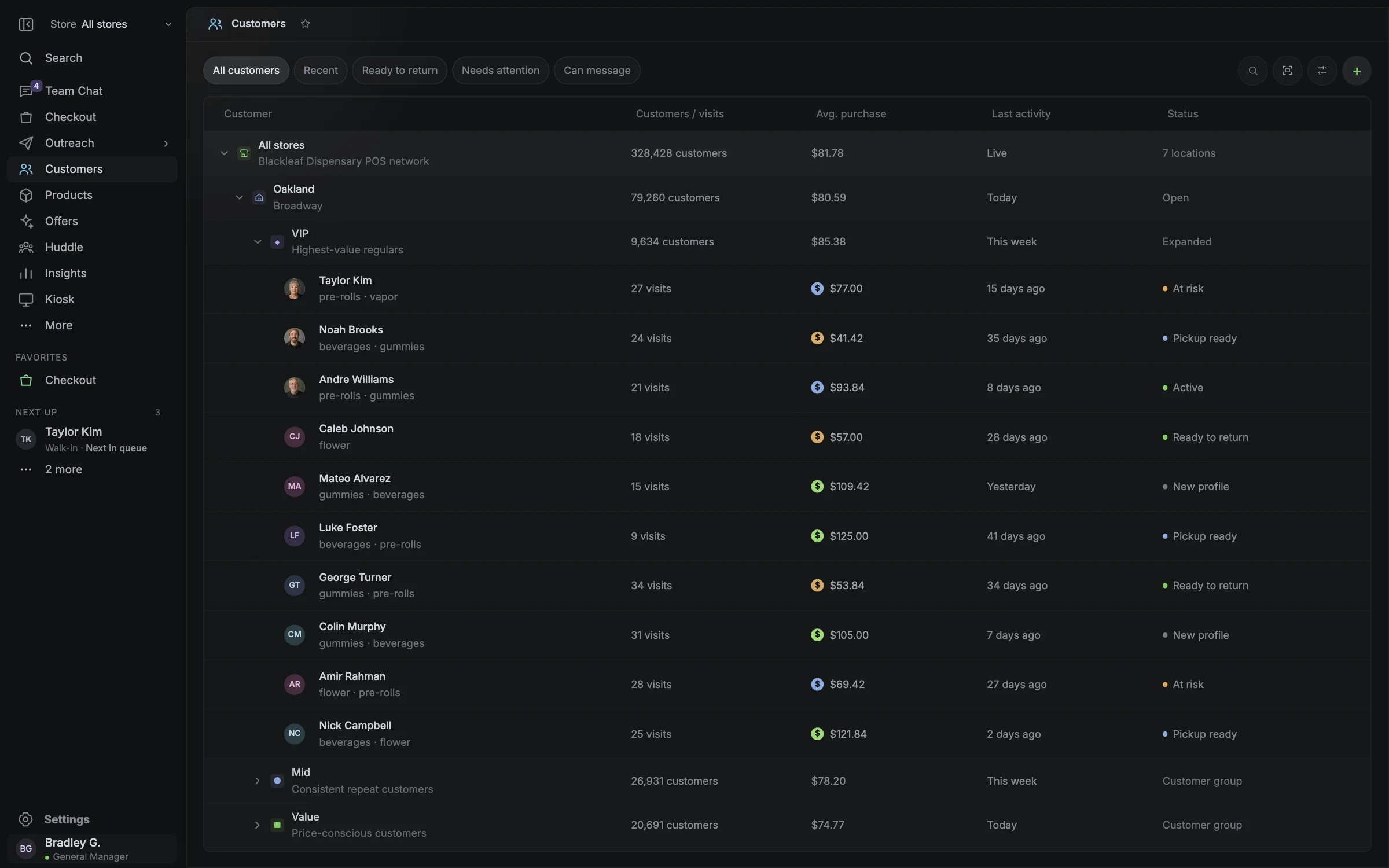
- Sample customer records
- Purchase context
- Separate messaging eligibility
Give each customer fact its own meaning.
A phone number helps identify a contact, a purchase records an event, and a preference describes an interest. None answers every question about the customer. Keep the source and update time with the information so the team knows what it can rely on. This map describes records to review, not fields promised by every Blackleaf POS deployment or connector.
| Record | What it tells you—and what to check |
|---|---|
| Identity | A store customer ID, verified contact detail and location can help match the shopper. A name alone, shared phone or duplicate profile can produce the wrong match. |
| History | Completed items, transaction date, location and returns describe past activity. They do not establish current stock, today’s intent or permission to text. |
| Likes | A shopper’s stated category, budget or format preference can guide a conversation. Keep it distinct from an interest inferred from purchases, and ask what they want today. |
| Rewards | A balance, tier or reward needs current eligibility and redemption rules. Loyalty enrollment does not itself establish a marketing-text subscription. |
| Consent | Keep the actual signup source, time, disclosure and message scope. A phone number collected for a receipt does not establish permission for a promotion. |
| Opt-outs | Check current opt-outs and other applicable exclusions at activation. An old purchase import or profile merge must not silently restore a suppressed contact. |
Match the person before using the history.
Start with the supported customer identifier and location mapping. Normalize contact details through the approved process, then review conflicts rather than automatically joining records because they share a name or number. A household may share a phone; a reassigned number may now belong to someone else. Keep unidentified orders separate until the authorized matching process resolves them.
- Review duplicate profiles, changed phone numbers and customers who shop at more than one store.
- Confirm what a merge preserves: purchases, returns, rewards adjustments, contact changes and permission evidence.
- Agree which source owns each field and how a newer value wins over an older import.
- Limit access and exports to the information needed for the approved job; a marketing handoff does not need an identity-document image.
Use history to start a conversation.
Someone who often buys a value-priced vape may be shopping for a gift today. Purchase context gives the budtender a starting point, not an instruction to repeat the last basket. Ask what matters now, then check available products and the current price. A requested item can become a useful follow-up idea, but only through a supported, permitted messaging workflow.
- Distinguish a stated preference from a pattern inferred from past transactions.
- Review completed sales separately from returns, voids and canceled orders.
- Check how much history was imported and when it last refreshed before calling someone inactive or a frequent visitor.
- Do not infer a medical condition or treatment need from a cannabis purchase or product preference.
Explain the reward the store can honor.
The sample workspace shows customer and rewards context. For a live rollout, confirm the implemented earning, redemption, expiry, tier and return behavior before staff quote a balance or promise a benefit. A screen showing points does not establish that every rule from an existing loyalty provider has migrated.
- Reconcile opening balances and supported history with the source program before activation.
- Confirm locations, eligible products, minimum spend, stacking and redemption limits.
- Rehearse a redemption, a return and a changed balance in an authorized test environment.
- Keep loyalty membership, reward eligibility and messaging permission as separate records.
Move from context to a reviewed message.
A purchase pattern can suggest who might value an update. Before contact, the workflow still needs a reliable match, current permission, supported source data and an offer the intended store can honor. This is a planning diagram for your team; it does not claim that connected POS outreach or every check runs automatically today.
| Handoff | Decision before moving on |
|---|---|
| 01 · Record → context | Identify the actual completed purchase or stated preference, store, source and latest update. Missing or stale data needs review. |
| 02 · Context → matched person | Resolve the customer/contact match and duplicates. Uncertain identity stays out of the proposed audience. |
| 03 · Person → eligible audience | Check the message’s permission scope, current opt-outs and exclusions. A matching record alone is insufficient. |
| 04 · Audience → approved invitation | Verify the permitted business, content and sending route, offer terms, current sellable stock, location, message frequency and destination. |
| 05 · Review → send | Use the supported texting workflow and required team approval. A draft or simulated POS task is not a completed customer send. |
| 06 · Activity → next decision | Review delivery, replies, opt-outs and matched purchases separately. A matched sale does not prove the message caused it. |
Keep texting available with your current POS.
If the immediate goal is better customer communication, evaluate Blackleaf’s existing texting product alongside the POS you already use. Confirm the connector or authorized import, available fields, refresh timing and supported use case. A purchase-based audience, loyalty-balance message and pickup-ready alert need different inputs; one customer feed does not establish all three.
- Map the exact fields and event required for one useful workflow before requesting a broader export.
- Confirm plan requirements, setup work, source ownership and how opt-outs remain effective across updates.
- Use current permission evidence even when the contact arrived from an existing customer list.
- Blackleaf POS adoption is a separate store-operations decision.
Review production scope and sample workspace data.
Blackleaf has a working POS and production Metrc approval. Confirm the customer-record, rewards and history scope for your deployment. The public workspace uses sample people and activity. Connected POS AI agents are in production in California; available AI texting tools have their own separate scope.
- Ask to demonstrate the actual deployed customer record and a supported purchase or rewards update.
- Record the history available at launch, known gaps, refresh timing and who resolves mismatches.
- Confirm permitted staff actions, supported exports and the response to a delayed feed.
- Agree go-live criteria and a named owner for customer matching, rewards questions and messaging eligibility.
Questions worth asking.
Clear answers for planning your store’s next step.
What is dispensary POS customer management?
It connects a shopper’s identity with store visits, purchases, preferences and rewards so staff can understand the available context. Confirm the actual fields, imported history, update timing and access for the deployment. A customer record and a marketing-text subscription are separate.
Do we need Blackleaf POS to use Blackleaf texting?
No. Blackleaf texting is available separately and can work alongside a supported existing POS or authorized import. Confirm the plan, available fields, timing, permission and messaging eligibility for the workflow. POS adoption is a separate store-operations decision.
Does a purchase or loyalty account give permission to send promotional texts?
No. Keep actual opt-in evidence and message scope separate from purchases, age checks and loyalty enrollment. Check current opt-outs and applicable exclusions before activating the proposed message. Consent or registration alone does not establish support for every business, message or sending route.
How should duplicate customer profiles be handled?
Use the supported identifiers and store mapping, then review conflicts before merging. Shared phones, reassigned numbers and duplicate names can create incorrect matches. Confirm what history, rewards and permission evidence a merge preserves. An older record must not silently reactivate an opted-out contact.
Is purchase history the same as a customer preference?
No. Purchase history records what happened; a stated preference records what the shopper told you. A pattern can suggest a relevant question, but it does not establish today’s intent or a medical need. Keep the source and update time clear and ask what matters now.
Can we bring existing loyalty points into Blackleaf POS?
Review the actual migration and rewards scope for the California production. Reconcile opening balances, supported history, earning, redemption, expiry, tiers, locations and returns before activation. A sample balance does not prove every rule from another loyalty program is supported.
Is customer history always current across the POS and texting?
No. An import, scheduled sync and event feed can have different timing. Confirm which fields update, the direction, history coverage and latest refresh. A recent customer sync does not establish live inventory or a pickup-ready event. Pause dependent outreach when required information is missing or stale.
Can POS AI automatically choose customers and send messages?
Blackleaf’s connected POS AI agents are in production in California. Confirm the specific enabled actions and approval controls before planning live outreach. Available AI texting preparation has its own scope; a generated draft or simulated task is not a completed customer send.
Are the people and results in the customer preview real?
No. The working demo uses sample people, preferences, purchase context and results to illustrate the workspace. It does not establish live customer imports, production rewards coverage, connected outreach or customer performance.
Is Blackleaf POS available to every dispensary now?
Blackleaf POS is in production in 11 states. Confirm the scope of Blackleaf’s production Metrc approval for your licensed facility. Confirm customer-management setup, migrated history and rewards rules for your licensed store.