- Start here
- What dispensary text marketing includes
- Check permission and provider policy before sending
- Build a campaign brief before writing copy
- Dispensary text marketing examples to plan around
- Set timing and frequency across every workflow
- What dispensary text marketing costs
- Separate attributed sales from incremental results
- Track a small, clearly defined scorecard
- Use AI and POS data to improve the brief
- Common mistakes to catch before launch
- Your first campaign checklist
- Dispensary text marketing FAQ
- Sources and next steps
Dispensary text marketing is permission-based customer communication through SMS and MMS, used for relevant updates, customer service, and permitted retention campaigns. A useful program connects a real customer need with an accurate message, an eligible audience, and a measurable store outcome.
This guide covers strategy, examples, costs, and measurement for dispensary owners and marketers. For product capabilities and plans, visit Blackleaf dispensary texting software.
Start with the customer, then plan the text
A customer comparing stores may care about a specific product, availability, price, or pickup convenience. A larger discount is not automatically the better fit. Ask what useful, verified information your store can provide at that moment.
- Choose one outcome: a completed pickup, a return visit, or a relevant customer response.
- Define eligibility: current permission, supported use case, location, and relevant customer signals.
- Verify the promise: inventory, price, offer terms, store hours, and the destination page.
- Review the result: delivery, responses, matched purchases, costs, and opt-outs.
What dispensary text marketing includes
SMS carries text and links. MMS adds media, such as a flyer, with different billing and size limits. Choose media when it helps explain the message; do not assume an image will improve sales. See SMS versus MMS for the format details.
A scheduled campaign addresses a defined audience. An automation responds to an event or rule, such as an eligible customer reaching a return-visit interval. An order alert communicates a real order event. These workflows need their own purpose, eligibility checks, and measurement.
Keep promotions separate from operational notices. Calling a promotion an “account update” does not change its purpose. Transactional and promotional texts require careful distinctions.
Check permission and provider policy before sending
Customer consent, cannabis advertising rules, and provider or carrier policy are separate requirements. A lawful business with opted-in customers can still have an unsupported SMS use case. Registration, age verification, and neutral wording do not override that restriction.
For example, Twilio’s current cannabis/CBD policy prohibits those businesses from using its U.S. and Canadian SMS/MMS services regardless of message content, including account activity. That is Twilio’s policy, not a statement about every provider. Confirm the actual business, route, geography, and message purpose with your provider before launch.
- Keep the opt-in source, timestamp, disclosure version, and scope of permission. A purchase or imported phone number is not evidence of marketing consent.
- Make withdrawal straightforward and honor reasonable revocation requests, including requests received outside a keyword flow. The current federal telephone solicitation rules address consent and revocation; state and cannabis-specific requirements need their own review.
- Use the applicable sender registration process. Keep registration accurate rather than presenting a cannabis business as a different category.
- If a route does not permit the use case, choose an allowed channel. Do not conceal the purpose behind an account notice or link.
Use SMS opt-in planning, Blackleaf’s compliance resources, and 10DLC for dispensaries to prepare specific questions for your provider and legal adviser.
Build a campaign brief before writing copy
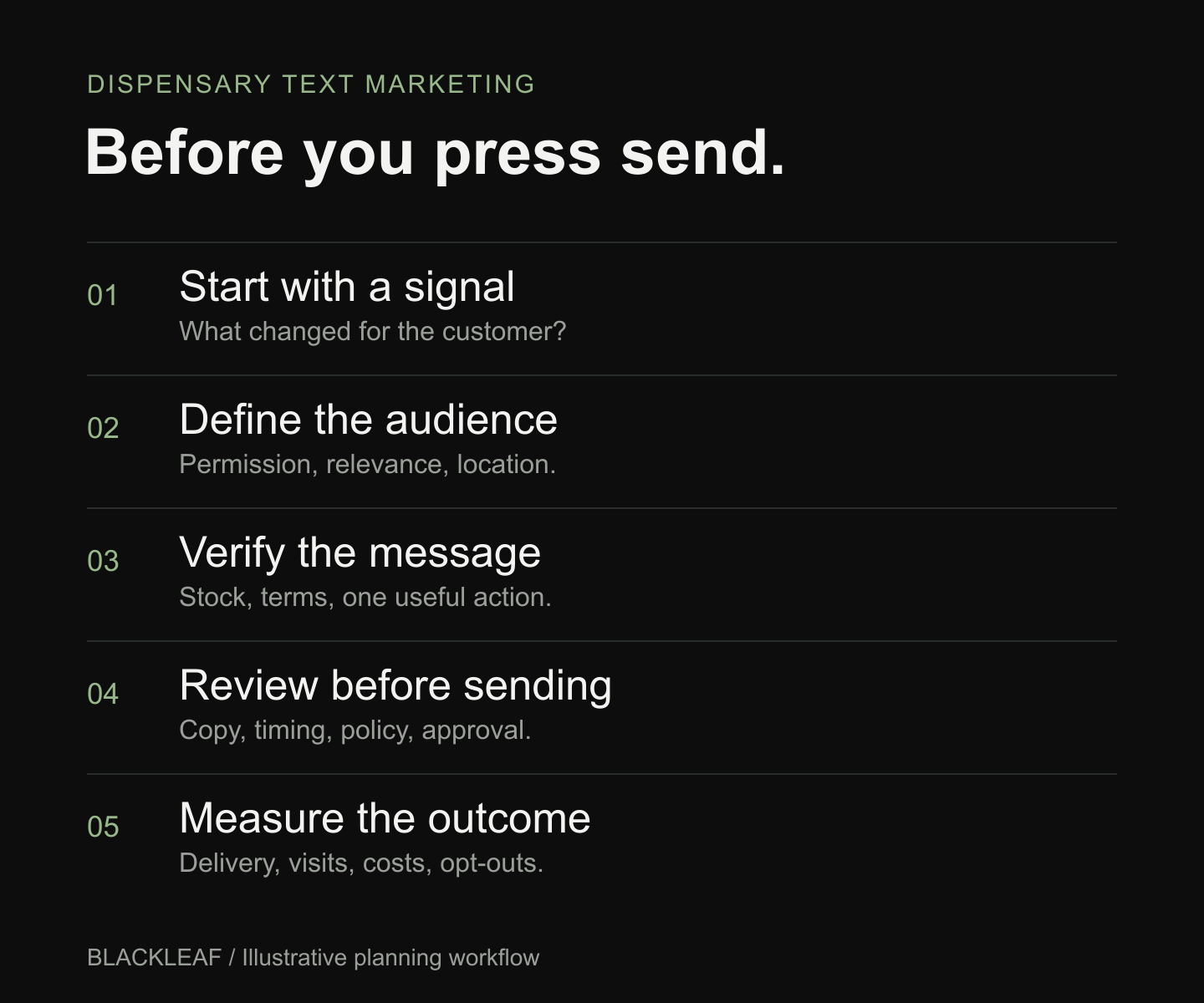
Use this five-part workflow for a permitted campaign. It gives the marketer, store team, and approver the same facts to work from.
- Signal. What changed for the customer? Use an explicit preference, a recent order, or a relevant purchase pattern. Treat an inferred preference as a hypothesis, not a certainty.
- Audience. Define who qualifies, which store serves them, and who must be excluded. Remove opt-outs, incompatible permissions, and customers who already completed the intended action.
- Message. State the actual reason to care. Confirm the product or service is available and every offer term is correct.
- Review. Check the audience, copy, link, timing, applicable policy, and approval. Preview the complete experience on a phone.
- Measure. Set the purchase or response window before sending. Record costs and an attribution rule that another team member can reproduce.
For a deeper audience plan, see dispensary SMS segmentation. Start with available data rather than building segments your system cannot reliably maintain.
Dispensary text marketing examples to plan around
These are illustrative planning examples, not customer results or blanket approval to send. Activate a workflow only when the actual business, content, permissions, and route are supported.
A relevant product update
A customer has asked for updates about a category. Before proposing a message, verify the current store inventory and the scope of that request. A previous purchase alone does not establish interest in every product or permission for marketing.
Brief: update only the eligible audience for that category and location; link to an accurate destination; exclude customers who already bought the featured item. Measure matched purchases and opt-outs under the same reporting window.
A return-visit campaign
A customer has not returned within the store’s chosen interval. That is a reason to test relevance, not evidence that the customer needs a discount. Compare a helpful update with an approved offer only if the audience and use case permit it.
Brief: choose the interval from actual visit patterns, suppress recent purchasers, and avoid overlap with other campaigns. Keep the offer valid at the recipient’s store and use a holdout when feasible.
A pickup-ready notice
An order is actually ready. The useful information is the pickup location, hours, and next step, without an added promotion.
Use a real readiness event, confirm reply handling, and follow the approved template and required disclosures. Measure pickup completion or support demand rather than treating the notice as a marketing sale. See order alerts.
Set timing and frequency across every workflow
Plan campaigns and automations together. A weekly campaign limit is ineffective if a customer also receives several triggered promotions.
- Count all marketing touches: combine scheduled campaigns and automated sends for each customer.
- Choose priority: decide which eligible workflow wins when two qualify at once.
- Recheck before sending: permissions, recent purchases, stock, and offer validity may have changed since the draft was prepared.
- Respect local timing: follow applicable quiet-hour requirements and the customer’s expectations.
There is no universal “two to four texts per week” rule. Start from what subscribers agreed to and test a deliberate cadence. Review delivery, opt-outs, complaints, and store outcomes by audience before increasing volume. See dispensary texting frequency.
What dispensary text marketing costs
The budget includes more than a quoted cost per text. Compare the complete monthly cost for the audience, formats, and workflows you plan to use.
- Platform: subscription, included usage, users, and any paid services.
- Messaging: SMS segments, MMS, applicable carrier fees, and how failed attempts or replies are billed.
- Setup: applicable registration, number, connection, and onboarding charges.
- Campaign economics: staff time, artwork, discounts, and any other offer cost.
A long SMS can span multiple billable segments; character encoding also affects segmentation. Twilio’s SMS length and encoding documentation explains that technical distinction. Ask your provider for a sample invoice based on your actual copy and audience rather than multiplying contact count by a headline rate.
Use Blackleaf’s current pricing for published plans and confirm the relevant billing details before budgeting. No fixed price in this guide should substitute for a current quote.
Separate attributed sales from incremental results
Attributed sales are purchases matched to a campaign under a chosen rule. They do not prove that the text caused the purchase. A customer may already have planned to visit, received another offer, or seen a message from a competing store.
Define the identity match, reporting window, treatment of returns, and credit for overlapping campaigns before comparing results. A unique offer code can help identify redemptions, but shared codes and purchases without codes still affect interpretation.
For a stronger test, randomly assign comparable eligible customers to a messaged group and a no-message holdout for that campaign. Keep other conditions as similar as practical and document contamination from other marketing.
If 20% of a messaged group and 15% of a randomized holdout return in the same window, the observed difference is 5 percentage points. It is not proof that all purchases in the messaged group came from the text. Sample size, uncertainty, other exposures, and test design still matter.
A before-and-after comparison can be useful when a holdout is impractical, but stock changes, holidays, competing promotions, and seasonality can explain the difference. Do not label that comparison a causal result.
Track a small, clearly defined scorecard
- Delivery rate: delivered messages divided by submitted messages, with failures and unknown statuses shown separately. Delivery does not mean the customer read the text.
- Opt-out rate: campaign opt-outs divided by delivered messages, using the same observation window each time.
- Matched purchase or return rate: qualifying buyers divided by the defined audience, with the matching rule and denominator stated.
- Attributed revenue per delivered message: matched net sales divided by delivered messages. This is a reporting ratio, not profit or incremental revenue.
- Incremental contribution: estimated extra contribution after product and offer costs, less program costs. If using net sales after discounts, do not subtract the same discount twice.
When a credible incremental estimate is available, calculate ROI as incremental contribution after program costs divided by program costs. Otherwise report attributed sales and costs separately, with the limitation explicit.
Use AI and POS data to improve the brief
AI can turn a store brief into draft copy and artwork. Blackleaf’s recurring Texting Agents can prepare drafts for review, with configured approval workflows. The practical benefit is help preparing the work; it is not proof of customer intent or permission to send. See AI dispensary text marketing for current capabilities and controls.
Give the draft a verified source of truth: the eligible audience, location, current stock, offer terms, brand voice, and intended action. Review generated details against that source before approval. AI should not invent a discount, product availability, customer preference, or sales result.
Supported POS data can help with purchase recency, category history, store mapping, and measurement. Confirm which fields are available, how often they update, and how permissions stay synchronized. Texting does not require every customer to switch POS systems. Start with POS-connected texting and the supported connection for your existing setup.
Common mistakes to catch before launch
- Sending a full-list promotion when only one location or audience can use it.
- Advertising unavailable stock, unclear exclusions, or an expired offer.
- Treating imported customer records as documented marketing permission.
- Calling an unsupported promotion an account notice to hide its purpose.
- Letting scheduled and automated messages overlap without a priority rule.
- Reporting all matched revenue as extra profit caused by texting.
If delivery fails, pause the affected workflow and inspect the actual error with your provider. Resolve permitted issues before resuming; do not rotate senders or disguise content to bypass a restriction. Use delivery troubleshooting to organize the investigation.
Your first campaign checklist
Before launch, name the outcome, confirm the supported use case, document audience eligibility, verify the message and destination, check timing and overlap, and record an attribution rule. Send a test through the approved process and get the required review.
After the reporting window closes, compare delivery, opt-outs, matched outcomes, and costs. Decide whether to repeat, change, or stop the workflow. Change one meaningful variable at a time when testing.
Dispensary text marketing FAQ
Can a dispensary text customers about promotions?
It depends on the law, the customer’s permission, and whether the provider and carriers permit the actual business and use case. Opt-in, registration, neutral wording, or an age-gated link alone does not establish permission to send cannabis promotions.
What is the difference between dispensary SMS marketing and order alerts?
Marketing aims to encourage a purchase or return visit. Order alerts communicate a real order event, such as pickup readiness. Keep the purposes and permissions separate; adding an offer can change the nature of an order message. Provider restrictions can apply to either workflow.
How often should a dispensary text customers?
Set frequency from the expectations given at opt-in, applicable requirements, customer preferences, and observed results. Count campaigns and automations together. There is no universal weekly number that is appropriate for every dispensary or audience.
How much does dispensary text marketing cost?
Budget for the platform, billable SMS segments or MMS, applicable carrier and registration fees, staff time, creative work, and any offer cost. Confirm what each plan includes and how usage is counted. A long SMS can cost more than a single message unit.
How do you measure ROI from dispensary text marketing?
Start with matched purchases under a documented attribution rule, then account for discounts, returns, product costs, and program costs. Attributed sales are not proof of extra sales. A well-designed randomized holdout can help estimate incremental contribution and return on program spend.
Do dispensaries need 10DLC for texting?
Ask which sender type and registration process apply to the proposed route. U.S. business messaging over local ten-digit numbers generally uses A2P 10DLC registration. Registration does not override restrictions on a business or message category and is not a delivery guarantee.
Can AI run a dispensary text marketing program?
AI can assist with briefs, copy, and artwork. Blackleaf also offers recurring Texting Agents that prepare drafts for review. Verify audience eligibility, inventory, terms, and approvals before sending. AI-generated copy does not establish consent, provider approval, or incremental sales.
Do I need to change POS systems to use Blackleaf texting?
A POS switch is not required for every texting customer. Start with the supported connection and data available from your current system. Confirm the fields, sync timing, location mapping, and permissions needed for your specific workflow with Blackleaf.
What should I do when a dispensary text is blocked?
Pause the affected workflow and inspect the actual rejection or delivery error with the provider. Resolve permitted registration, data, or configuration issues before resuming. Do not disguise the business, rotate senders, or move prohibited content behind a link to evade restrictions.
Sources and next steps
Policy and technical sources reviewed October 14, 2026: Twilio cannabis/CBD verification restrictions, A2P 10DLC background, and 47 CFR § 64.1200. These sources cover different requirements; confirm the rules and provider support applicable to your program.
For software evaluation, use the dispensary SMS platform guide. For an operational starting point, use Blackleaf’s SMS strategy assessment.
Plan a more useful dispensary texting program
Talk through your audience, current POS connection, supported use cases, and measurement needs with Blackleaf. Start with one clear workflow and the controls to review it.
Talk to Blackleaf