Introduction
Most dispensaries obsess over campaign copy and ignore the fine print. That is backwards. Your disclaimer language is what protects your program when a customer complains, a carrier audits traffic patterns, or a regulator asks questions.
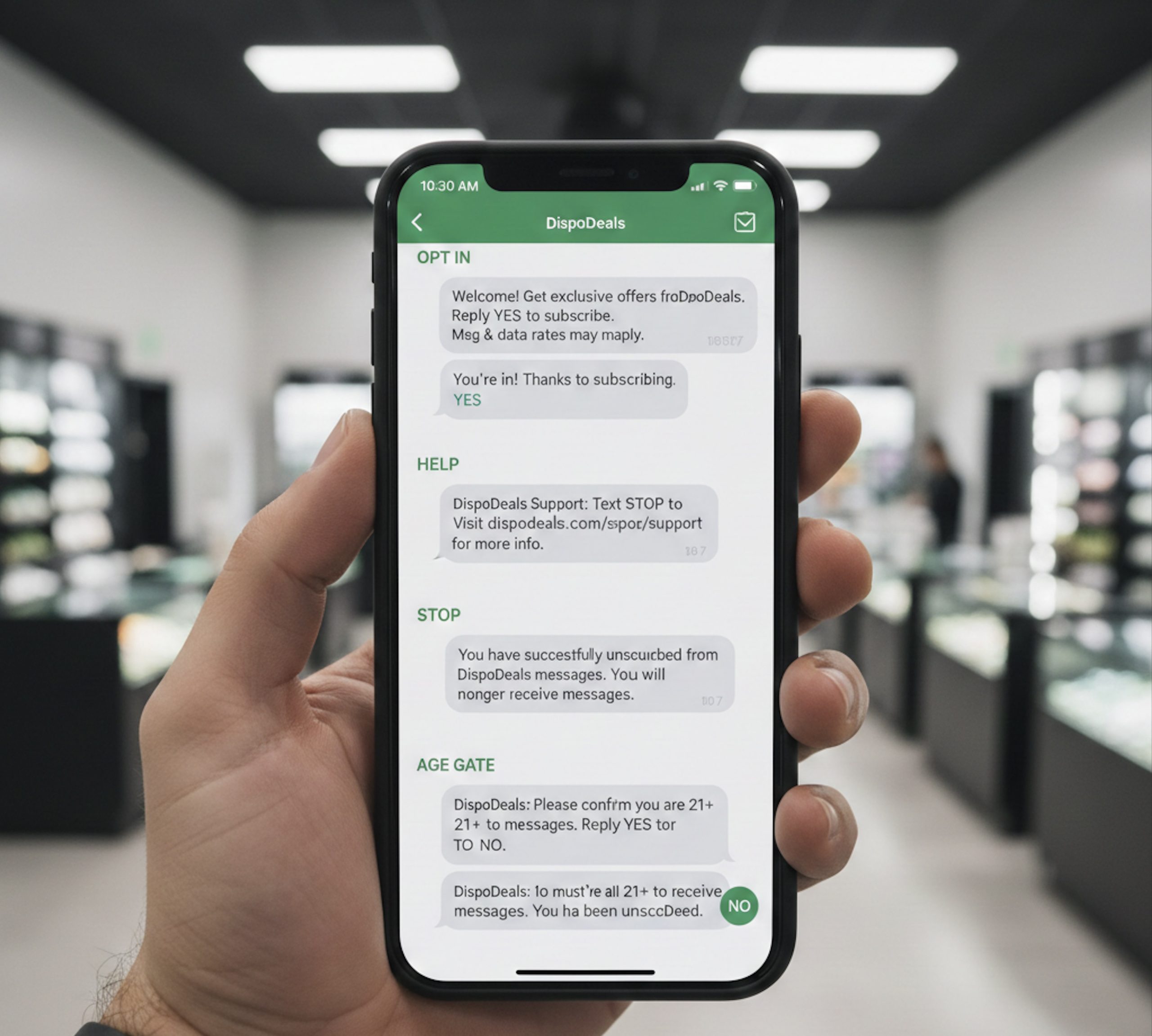
This guide is a working library of disclaimer examples for opt in, HELP, STOP, and age gate placements. It is designed for operators asking, “What exactly do I put on my site?” or “What should our QR landing page say?”
This content is operational guidance, not legal advice. Always align your language with your market’s regulations and your documented consent flow. For broader context, review compliance and cannabis SMS compliance.
What’s Really Happening
Carriers and ecosystem stakeholders evaluate messaging programs on consent clarity, opt out functionality, and content risk. Weak disclaimers are a red flag. Vague language like “Sign up for deals” without message frequency, opt out instructions, or data rate disclosures can contribute to filtering and complaints.
In cannabis, scrutiny is higher. You are operating in a regulated category that carriers already monitor closely. That means your disclaimers must be:
Clear about what messages customers will receive
Explicit about STOP and HELP functionality
Transparent about message and data rates
Separated from unrelated consent checkboxes
If you are running A2P 10DLC campaigns, your public language should also match what you declared during registration. Review 10DLC for dispensaries for alignment guidance.
Why It Matters for Dispensaries
Disclaimers do three things:
Protect you legally by documenting informed consent
Protect you operationally by reducing complaint rates
Protect you technically by reducing filtering triggers
When a customer reports spam, the first question is whether they gave clear consent. When carriers see high STOP rates, they look at expectation mismatch. Proper disclaimer placement reduces both.
Practical Implications
1. Website Opt In Form Disclaimer
Placement: Directly under the phone number field, not hidden in a footer.
Example:
“By entering your phone number, you agree to receive recurring automated text messages from [Dispensary Name] regarding order updates, account notifications, and store information. Message frequency varies. Message and data rates may apply. Reply STOP to opt out. Reply HELP for assistance.”
2. QR Code Landing Page Disclaimer
Placement: Visible before or immediately adjacent to the submit button.
Example:
“Join SMS to receive order updates, pickup notifications, and store communications. Message frequency varies. Message and data rates may apply. Reply STOP to unsubscribe. Reply HELP for help.”
3. In-Store Signage (Short Form)
Placement: On countertop sign with QR or keyword instructions.
Example:
“Text JOIN to 12345 for store updates and order notifications. Msg freq varies. Msg & data rates may apply. Reply STOP to opt out.”
Short form signage should be paired with a full disclaimer on the linked landing page.
4. Checkout Enrollment Screen
Placement: As a standalone SMS consent checkbox.
Example:
“I agree to receive automated text messages from [Dispensary Name] for order and account communications. Msg freq varies. Msg & data rates may apply. Reply STOP to opt out.”
Do not bundle this checkbox with email marketing or general terms of service.
5. Loyalty Signup Disclaimer
Placement: Immediately under SMS enrollment toggle.
Example:
“Enroll in SMS for loyalty account updates, reward notifications, and store communications. Message frequency varies. Message and data rates may apply. Reply STOP to unsubscribe. Reply HELP for assistance.”
6. Age Gate Confirmation Language
Placement: Before SMS opt in is accepted.
Example:
“By submitting your phone number, you confirm you are of legal age to purchase cannabis in your jurisdiction and consent to receive text messages as described above.”
This does not replace required website age gating, but it reinforces responsible marketing posture.
7. First Message Confirmation (Best Practice)
Placement: Immediately after opt in.
Example:
“You are subscribed to [Dispensary Name] text updates. Msg freq varies. Msg & data rates may apply. Reply STOP to opt out. Reply HELP for assistance.”
This confirmation reduces surprise and lowers early STOP rates.
Common Mistakes or Misconceptions
Hiding disclaimers in the privacy policy. Consent language must appear at the point of collection, not just in a legal page.
Forgetting HELP instructions. HELP functionality is expected in A2P programs.
Omitting message frequency language. Even if variable, you should disclose that frequency varies.
Not matching 10DLC registration language. Your public description should align with what you declared during campaign registration.
Using promotional promises that exceed actual usage. If you say “weekly updates,” do not suddenly send daily blasts.
If you receive recurring customer questions about your SMS program, consider updating your public FAQ page with a plain-language explanation.
FAQ
Question: Do we have to include message frequency in the disclaimer?
Answer: Yes. Even if the frequency varies, that should be clearly stated so customers understand what they are agreeing to.
Question: Is “Msg & data rates may apply” required?
Answer: It is standard industry language and strongly recommended to disclose potential carrier charges.
Question: Can we combine email and SMS consent into one checkbox?
Answer: It is best practice to separate them. Bundled consent can create ambiguity and increase complaint risk.
Question: Do we need to mention STOP in every message?
Answer: STOP instructions should be included at enrollment and periodically in campaigns. The program must technically support STOP at all times.
Question: Should disclaimers be different for delivery vs pickup programs?
Answer: The core language can remain consistent, but message descriptions should reflect actual use cases such as order updates or account notifications.
Question: Does age confirmation replace website age gating?
Answer: No. Age confirmation in SMS disclaimers is supplemental and does not replace required website-level age gate controls.
Metrics or Signals to Watch
| Signal | What It Indicates | Action |
|---|---|---|
| High STOP rate within 24 hours | Expectation mismatch | Clarify enrollment disclaimer and first message |
| Spam complaints | Weak or unclear consent | Audit placement and checkbox separation |
| Carrier filtering | Compliance or content misalignment | Review declared campaign use case and public language |
| Low HELP response handling | Support gaps | Ensure HELP routes to monitored support channel |
Disclaimers alone do not guarantee compliance, but they significantly reduce program risk when implemented clearly and consistently.
Sources and Further Reading
-
CTIA Messaging Principles and Best Practices outlines consent and disclosure standards for messaging programs.
-
The Campaign Registry provides A2P 10DLC registration guidance and campaign transparency expectations.
-
FCC telemarketing guidance summarizes TCPA-related consumer protection standards relevant to automated messaging.
-
FTC advertising guidance explains truth-in-advertising principles applicable to marketing claims.