- Summary
- The Dispensary Text Marketing System
- Definition
- How We Measure Attribution in Dispensary SMS
- Why This Matters for Dispensaries
- Step-by-Step Implementation
- Core Concepts and Workflows
- Example Text Messages You Can Send
- Account Credit Notifications
- Common Mistakes That Kill Dispensary SMS Performance
- Comparison Table: Message Types Dispensaries Actually Use
- Metrics That Matter in Dispensary Text Marketing
- Quick Answers
- FAQ
- Sources and Further Reading
If you have a customer list, you already own one of the highest-leverage channels in your business.
Dispensaries win with SMS when they treat texting like retention infrastructure. That means a predictable schedule, tight targeting, and rules that protect deliverability.
This page is a practical build guide for a dispensary SMS program that drives repeat visits and revenue while keeping list health stable.
Page Summary
- Measure what happens in the store. Use revenue per delivered message and repeat visits, not clicks.
- Segment by behavior. Recency, frequency, and category affinity let you send fewer messages and earn more per send.
- Automate high-intent moments. Carts, winback, and order-status messaging create predictable demand without blasting.
- Protect deliverability as infrastructure. Consent, suppression, and consistent sending behavior keep reach stable.
The Dispensary Text Marketing System
Most “SMS does not work” stories are system problems. The store is blasting the full list, sending inconsistently, or running campaigns and automations without suppression rules.
Treat your SMS program like a simple operating system and results become repeatable.
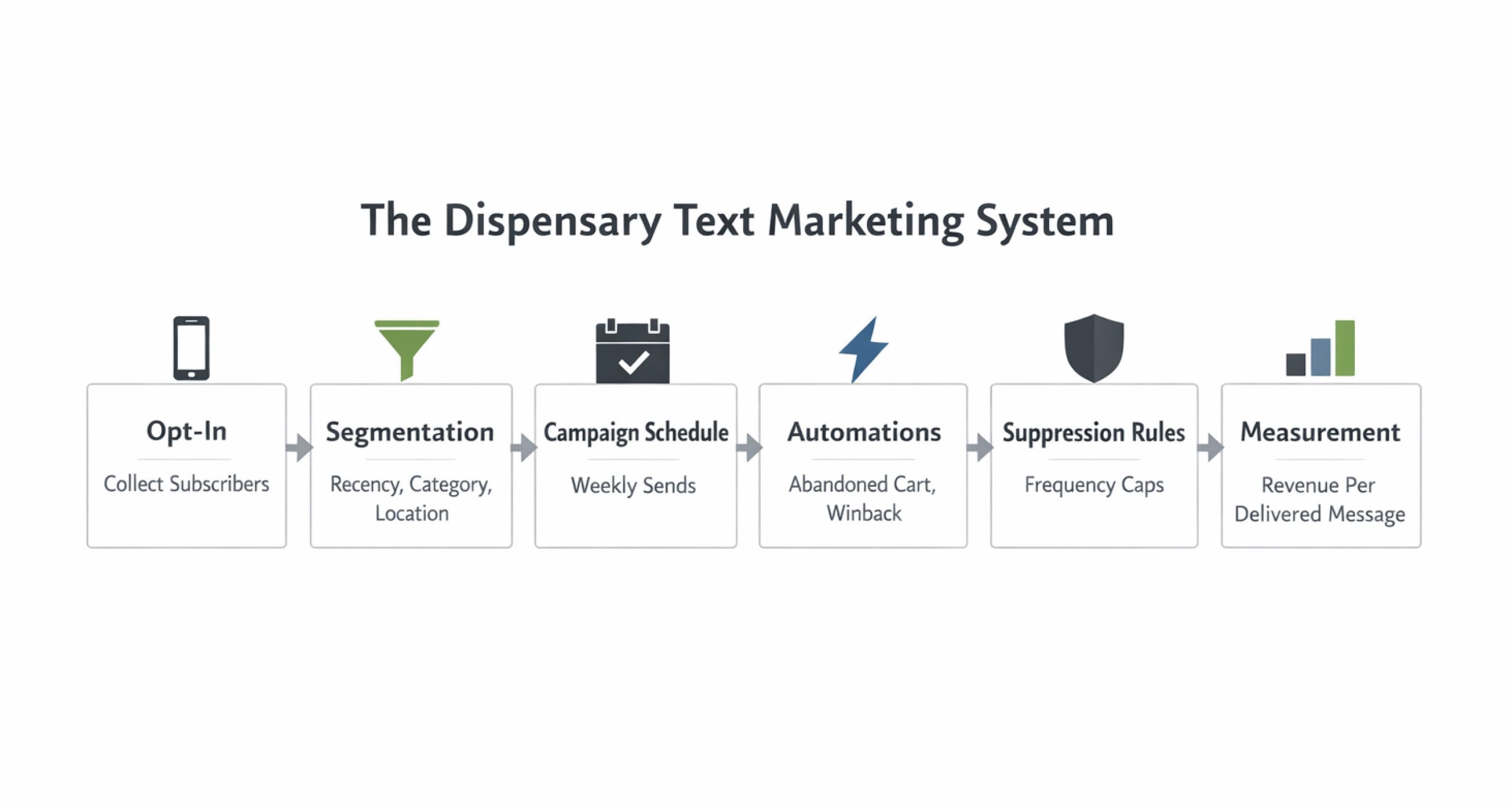
- Opt-in and expectations keep your list usable long-term. Start with SMS opt-in for dispensaries and age gating.
- Segmentation prevents over-sending and reduces opt-outs. Use this segmentation breakdown as your baseline.
- Suppression and measurement turn SMS from a “blast tool” into retention infrastructure. If reach feels inconsistent, anchor on deliverability and carrier filtering.
Carrier content enforcement matters. Carriers enforce restricted content categories and risky patterns. These rules are often summarized as SHAFT (Sex, Hate, Alcohol, Firearms, Tobacco), plus other regulated content and policy-based filtering. Your goal is not to write legal copy in every text. Your goal is to keep message patterns permission-based, predictable, and aligned to your registered use case so reach stays stable.
Definition
Dispensary text marketing is the use of permission-based SMS and MMS to drive repeat visits and revenue by sending targeted campaigns and automated lifecycle messages to customers who opted in.
This playbook is for dispensary owners, operators, and marketers who want predictable traffic and retention without burning their list. It applies to single-store teams and multi-location groups.
If you want the software side, start with Dispensary text messaging software. If you want deeper telecom concepts, reference the cannabis texting glossary. If you want the compliance layer, use SMS compliance and 10DLC for dispensaries.
How We Measure Attribution in Dispensary SMS
Dispensary SMS attribution is strongest when it matches retail reality. Instead of relying on clicks, measure what changed in the store after a send.

- Product lift: compare performance of featured categories or products before and after a send (use the same day-of-week baseline).
- Holdout comparison: compare revenue and visits for customers who received messages versus customers suppressed from that send.
- Customer value effect: track how opt-in status correlates with spend and visit frequency over time, then protect list health accordingly.
If results feel inconsistent, the cause is usually one of three things: deliverability drift, list fatigue, or unclear audience rules. Start with deliverability, review carrier filtering, then tighten segmentation with this segmentation breakdown.
Why This Matters for Dispensaries
Dispensary SMS works when it is treated like a retention system, not a megaphone. Results are the destination. Deliverability and consent are the travel that keeps results stable.
- More repeat visits within 30 to 90 days (measured by return rate, not replies).
- Higher revenue per delivered message by narrowing sends to customers most likely to buy.
- Fewer slow days by using triggers that create predictable traffic.
- Lower opt-out rate through better relevance and tighter frequency control.
- More reliable reach by reducing filtering and rejected campaigns.
If reach is inconsistent today, fix the delivery layer before scaling volume. Use Dispensary SMS deliverability as your baseline, then review carrier filtering and SMS deliverability troubleshooting.
The ROI rule that keeps your program healthy
If a message type cannot earn back its share of opt-outs and complaints, it is not an extra campaign. It is a tax on future revenue. Keep what drives repeat visits. Cut what hurts reach.
Step-by-Step Implementation
This build order gets to revenue quickly, while keeping deliverability and consent stable enough to scale.
-
Choose a single north-star metric. Start with revenue per delivered message (or revenue per send) so the team optimizes for profit, not volume. If you want a structured scoring method, run the Dispensary SMS strategy assessment.
-
Separate transactional and marketing traffic. Keep order and support messages distinct so expectations stay clear. For operational messaging, anchor with order alerts. For definitions, see transactional vs promotional dispensary texts.
-
Lock in opt-in, disclosures, and opt-out handling. Make consent easy to give and easy to withdraw. Treat this as revenue protection because it keeps your list usable. Use opt-in and consent for dispensaries and SMS opt-in for dispensaries. If you need an age gate pattern, use age gating. For compliance foundation, see TCPA compliance.
-
Build your first three segments. Recency, category affinity, and location (if multi-store). If segments are not tied to purchase behavior, you will over-send.
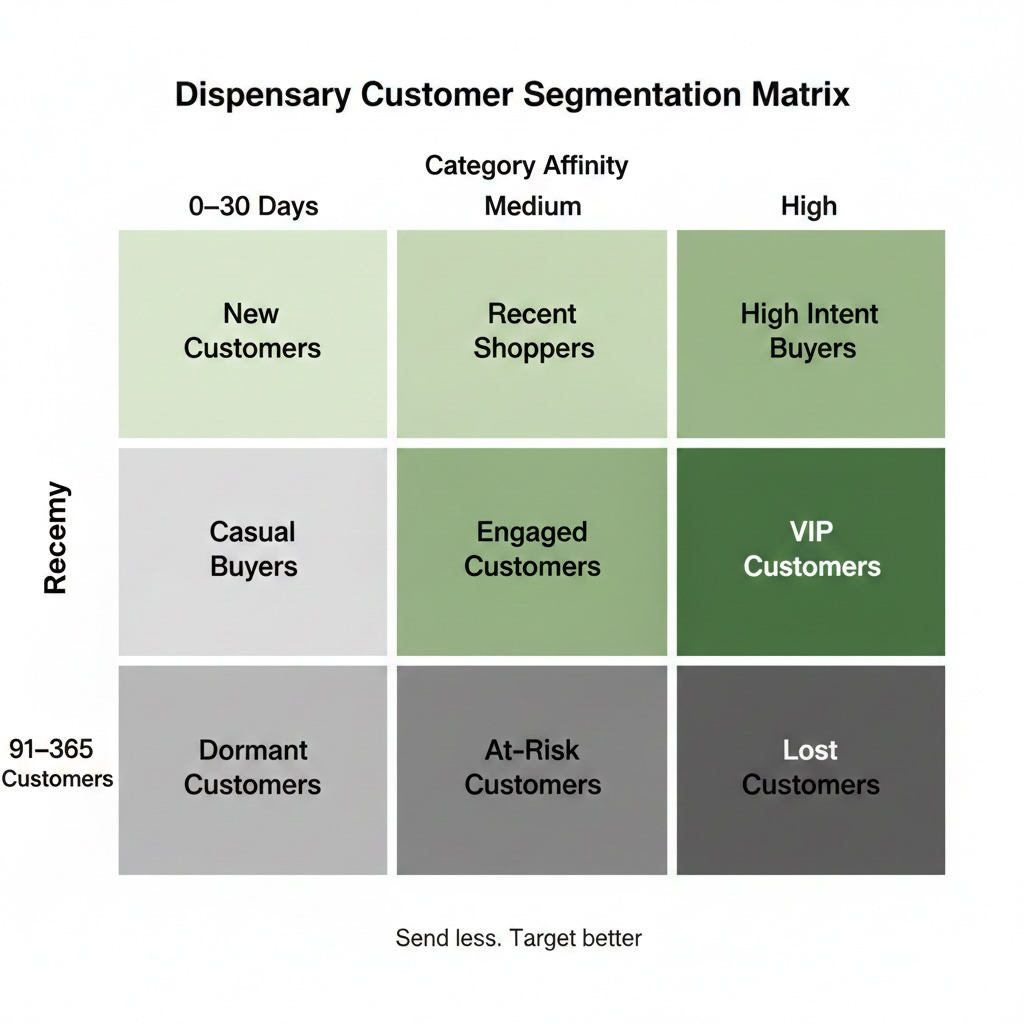
Start with recency and category affinity so you can send fewer messages and earn more per delivered text. Start with the segmentation playbook: stop blasting and start driving repeat visits. If you are multi-store, add governance using multi-location SMS strategy.
-
Set a frequency cap and suppression rules. Decide the maximum marketing touches per week and prevent overlaps between campaigns and automations. If you are running campaigns, use a structured approach like dispensary mass texting strategy. For practical frequency guidance, see how often dispensaries should text customers.
Rule Default starting point Why it matters Marketing frequency cap 2 to 4 touches per week (by segment) Reduces fatigue and opt-outs while keeping demand predictable Suppression window 24 to 72 hours Prevents customers from receiving multiple messages close together Collision rule Flows yield to campaigns or vice versa, but never both Keeps customer experience consistent and measurable -
Launch two core automations first. Start with abandoned cart and winback because they target high-intent moments. Use Dispensary SMS automations as the operating model, plus SMS automation flows for dispensaries for flow patterns. For reference solutions, see abandoned cart SMS and winback SMS.
-
Standardize copy patterns. Use consistent identity, context, one action, and opt-out language. Keep templates organized so new staff do not freestyle risky messages. Pull from Dispensary SMS templates and review compliance disclaimer examples.
-
Connect attribution to POS reality. Tag every campaign and flow so you can measure return visits and revenue. For POS-driven segmentation, use POS texting for dispensaries and how POS-powered SMS actually works.
-
Review weekly and prune aggressively. Keep messages that drive revenue per delivered message and repeat visits. Pause anything that increases opt-outs or reduces reach, then troubleshoot using SMS deliverability troubleshooting, carrier filtering, and dispensary SMS deliverability.
Core Concepts and Workflows
- Revenue per delivered message: attributed revenue divided by messages delivered (use one definition consistently).
- Segment-first planning: decide who and why before writing copy.
- Lifecycle ladder: trust-building messages first, then retention flows, then broader campaigns.
- Suppression and frequency caps: prevent collisions across campaigns and automations.
- Deliverability as infrastructure: stable sending behavior and predictable patterns that keep reach consistent.
- Automation for intent: triggered messages tied to customer behavior beat generic blasts.
If you want a deeper foundation on compliance and carrier behavior, use TCPA compliance, 10DLC for dispensaries, SMS compliance, and carrier filtering.
Segmentation is how you send fewer texts and make more money
If you are blasting the full list, you are paying for non-buyers, driving opt-outs, and training carriers to distrust your traffic. Segmentation fixes all three.
Example Text Messages You Can Send
Below are compliant examples structured as account-related notifications. Each message points the recipient to view details securely within their account.
- Use when a real account message exists for that customer.
- Keep the link short and customer-specific.
- Use for real profile updates that the customer can see in-account.
- Use only if a meaningful update exists for saved preferences.
- Use when a real document is present and accessible.
- Use for general account alerts when specifics are available in-account.
Account Credit Notifications
Examples of compliant credit-related account notifications. These messages must reflect actual account-level balance updates for the recipient.
- Only send if the credit is real and visible inside the account.
- Only send if a real expiration timestamp exists for that customer.
- Use when a real balance update occurred.
Common Mistakes That Kill Dispensary SMS Performance
- Measuring clicks instead of store outcomes. Clicks can be directionally useful, but repeat visits and revenue per delivered message are what pay the bills.
- Blasting everyone because it is faster. You trade short-term convenience for long-term reach loss.
- Letting campaigns and automations collide. Without suppression, one customer can receive multiple messages close together.
- Mixing promotions into transactional messages. It confuses expectations and increases complaints. Use transactional vs promotional as your guideline.
- Changing sender identity too often. Consistency supports recognition and reduces opt-outs. For patterns, see branded sender for dispensary SMS.
- Ignoring early deliverability signals. Gradual reach decline is easier to fix than a full block. Use SMS deliverability troubleshooting when performance drops.
Comparison Table: Message Types Dispensaries Actually Use
| Type | Trigger | Message Type | Risk Level | Primary Goal |
|---|---|---|---|---|
| Order received | Customer places an order | Transactional | Medium | Reduce uncertainty and support pickup completion |
| Pickup ready | Order marked ready | Transactional | Medium | Fewer missed pickups and faster throughput |
| Abandoned cart reminder | Cart inactivity window | Lifecycle automation | High | Recover revenue without increasing blast frequency |
| Winback sequence | Time since last purchase | Lifecycle automation | High | Increase repeat visits from lapsed customers |
| Category update | New inventory or restock | Campaign (segmented) | High | Drive sell-through in priority categories |
| Event reminder | Scheduled date and time | Campaign (scheduled) | Medium | Create predictable traffic on planned days |
If you want a deeper breakdown of SMS vs MMS and when to use each, see SMS vs MMS explained.
Metrics That Matter in Dispensary Text Marketing
If you track only one metric, track revenue per delivered message. If you track five, track the list below.
- Revenue per delivered message (primary)
- Repeat visit rate (30, 60, or 90 days)
- Opt-out rate per send (fatigue signal)
- Delivery rate trend (stability signal)
- Automation contribution (flows vs campaigns)
If you want a structured way to score your program and identify the biggest ROI gaps, run the Dispensary SMS strategy assessment. If you are tuning frequency, use how often dispensaries should text customers.
When ROI drops, do not send more
Reduce audience size, tighten segments, and clean up collisions between campaigns and automations. Most “SMS stopped working” problems are relevance, frequency, or deliverability drift.
Quick Answers
Dispensary text marketing is permission-based SMS and MMS used to drive repeat visits and revenue through targeted campaigns and automated lifecycle messages sent to customers who opted in.
- Defined audiences (segments based on purchase behavior)
- Predictable cadence (a schedule with frequency caps)
- Automations (messages tied to high-intent events)
- Suppression rules (prevent collisions and fatigue)
- Measurement (revenue per delivered message and repeat visits)
- Lock in opt-in and expectation-setting, plus age gating if needed.
- Create 3 starter segments: recency, category affinity, and location (multi-store).
- Set a frequency cap and suppression rules so campaigns and flows do not overlap.
FAQ
Can a dispensary use text marketing to drive repeat visits without blasting the whole list?
Yes. Start with recency and category segments, then use automations for winback and carts. The goal is fewer, better-targeted messages that increase revenue per delivered message.
Can a dispensary text customers about promotions?
Yes, when customers opted in to receive marketing and your program expectations match what you send. Treat consent and clear opt-out handling as revenue protection because it keeps deliverability stable.
What happens when you text too often?
Opt-outs rise, engagement drops, and reach can become less consistent. Even if short-term revenue spikes, you usually pay for it later through list fatigue and filtering.
What happens when carriers filter or block a dispensary campaign?
Reach can drop quickly and your best customers may never see the message. Pause scaling, send to smaller segments, clean up copy patterns, and troubleshoot sending behavior and registration alignment.
How do you measure ROI from dispensary text marketing?
Tie each campaign and automation to sales and repeat visits, then track revenue per delivered message and repeat visit rate by segment. Use consistent attribution rules so you can compare performance week to week.
What is the difference between SMS marketing and order alerts?
Order alerts are transactional messages triggered by customer actions and order status. SMS marketing is campaign and lifecycle messaging designed to bring customers back and increase repeat purchases.
Do dispensaries need 10DLC for texting?
In the U.S., many business texting programs are expected to align with A2P 10DLC registration and an accurate campaign use case. It supports carrier trust, which helps protect deliverability and revenue.
How do you reduce opt-outs from dispensary SMS?
Tighten segmentation, lower frequency, and improve expectation-setting at opt-in. If one segment opts out more than others, stop sending to it until the message type is fixed.
Sources and Further Reading
FCC: Stop unwanted robocalls and texts
eCFR: 47 CFR § 64.1200 (TCPA regulations)
CTIA: Messaging Principles and Best Practices (PDF)
The Campaign Registry (A2P 10DLC)
CTIA: SHAFT Content Guidelines (Prohibited Messaging Categories)
Related Blackleaf Pages
Want a dispensary SMS program built around revenue per delivered message?
Get a clear plan for segmentation, frequency, and automations, with deliverability and consent handled as infrastructure so results stay stable.
Talk to Blackleaf