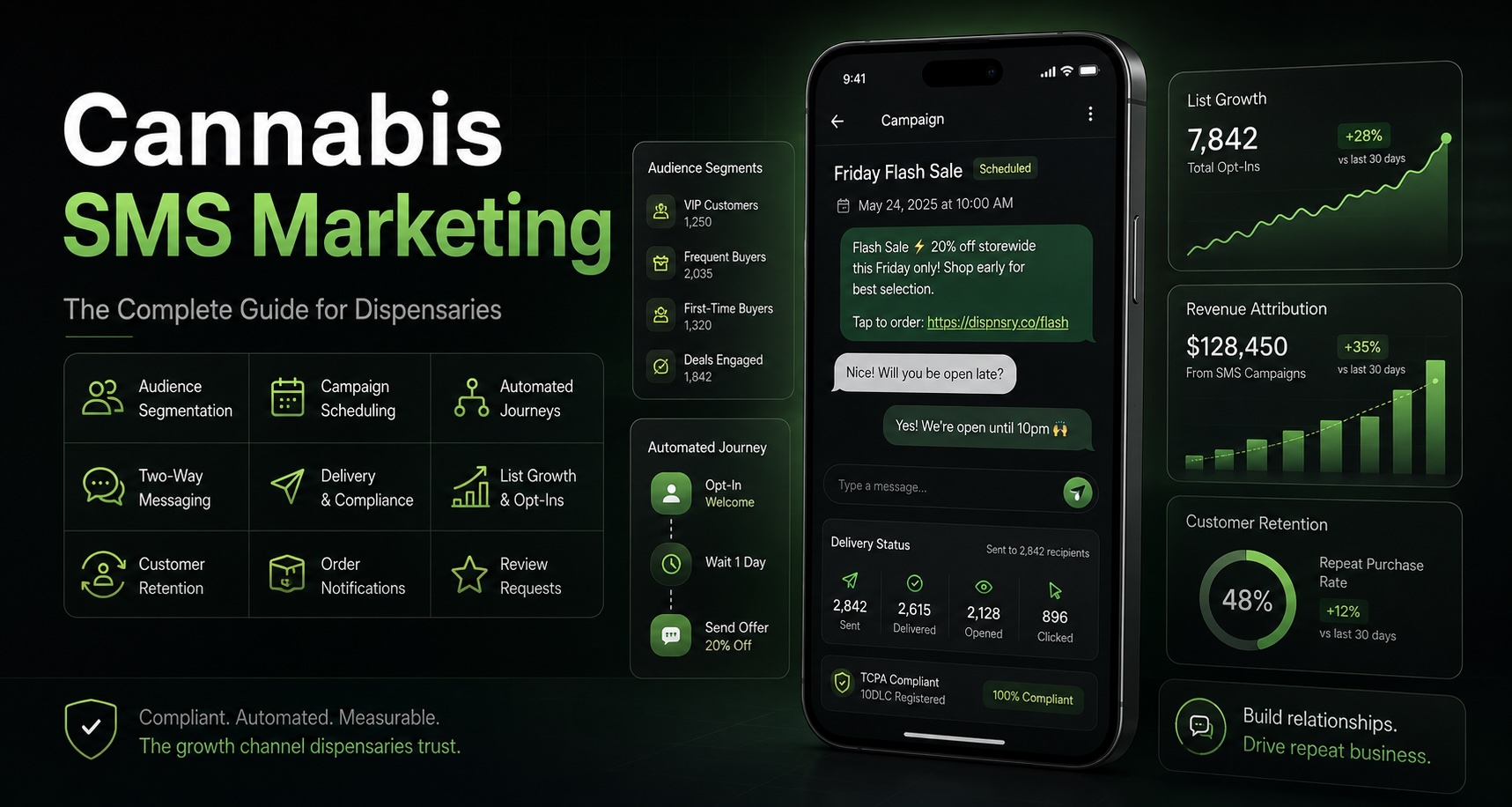
Cannabis SMS marketing is the use of permission-based text messages to communicate with dispensary customers. It includes promotional campaigns, automated retention messages, order updates, review requests, loyalty communication, and two-way conversations. Because cannabis businesses face additional carrier and age-restriction requirements, an effective program depends on documented consent, appropriate message routing, careful audience selection, reliable opt-out handling, and measurable campaign goals.
Cannabis SMS marketing gives dispensaries a direct way to communicate with customers who have chosen to hear from them. Unlike a social media post, a text does not depend on an algorithm deciding whether the customer sees it. Unlike an app notification, it does not require the customer to keep a dispensary application installed.
That direct access is valuable, but it also creates responsibility. Dispensaries should not treat a phone-number database as permission to send every promotion to every customer. The strongest programs are built around consent, relevance, timing, customer preferences, deliverability, and a clear business purpose for each message.
This guide explains how cannabis text message marketing works, why it is different from conventional retail SMS, which campaigns dispensaries can use, how message costs are calculated, and how operators can measure whether texting is actually contributing to repeat visits and revenue.
What is cannabis SMS marketing?
Cannabis SMS marketing is a customer communication strategy in which a dispensary or cannabis business sends text messages to people who have agreed to receive them from that identified business.
The term is commonly used alongside dispensary text marketing, SMS marketing for dispensaries, and cannabis text message marketing. Each describes the same basic channel, but the strategy can include far more than promotional text blasts.
Promotional campaigns
Messages about store events, approved offers, new services, loyalty benefits, and other reasons for customers to visit.
Automated retention
Messages triggered by customer inactivity, birthdays, purchase behavior, loyalty milestones, or other lifecycle events.
Transactional communication
Order confirmations, pickup notifications, account updates, digital receipts, and other service-related messages.
Two-way messaging
Direct conversations between customers and store teams for questions, assistance, clarification, and follow-up.
A complete cannabis SMS strategy combines these message types without overwhelming customers. Promotional campaigns can create short-term traffic, while automations and service messages help the dispensary maintain an ongoing customer relationship.
Why cannabis SMS marketing is different
A conventional retailer can usually choose from a large number of general messaging vendors. Cannabis businesses operate in a more restrictive environment.
A dispensary may be properly licensed under state law while still being restricted by a software provider, downstream messaging vendor, mobile carrier, payment processor, or another company involved in transmitting the message. These private policies can be more restrictive than the laws that govern the dispensary itself.
That difference affects platform selection, sender registration, message content, link destinations, age controls, campaign review, and the way delivery problems are handled.
A cannabis-friendly SMS platform is not simply a general SMS tool with cannabis-related words removed. The provider should understand the business category, the intended messaging use case, the signup process, age restrictions, opt-out requirements, carrier policies, and the operational controls needed to support regulated messaging.
Dispensaries should also avoid strategies designed to disguise their identity or evade filtering. Replacing words with unusual spelling, spreading traffic across disposable numbers, or hiding the true destination of a link does not create a stable messaging program. It can increase delivery problems and make the underlying account harder to support.
How cannabis SMS marketing works
The exact workflow differs by platform and dispensary, but most permission-based programs follow the same general process.
The customer provides consent
The customer knowingly signs up to receive messages from the identified dispensary or cannabis business.
The consent record is stored
The dispensary records the phone number, signup source, consent status, date, and any other information needed to document the customer relationship.
The customer enters an eligible audience
The platform uses available customer data and suppression rules to determine which people may receive a particular message.
The campaign or automation is prepared
The dispensary selects the message, audience, timing, link, expiration, and business outcome associated with the send.
The message is transmitted
The platform sends the message through the appropriate messaging infrastructure and records delivery events, failures, replies, and opt-out requests.
The dispensary measures the result
The operator reviews delivery, clicks, visits, redemptions, revenue, repeat purchases, replies, or another relevant outcome.
The next campaign improves
Performance data is used to refine audience selection, message structure, timing, frequency, and campaign strategy.
Cannabis SMS campaigns dispensaries can use
The best campaign type depends on what the dispensary needs the customer to do. A store trying to generate weekend traffic requires a different message than a store trying to recover inactive customers or notify someone that an order is ready.
| Campaign type | Primary purpose | Typical trigger | Useful measurement |
|---|---|---|---|
| Store promotion | Generate visits during a defined period | A weekend, event, holiday, or approved offer | Visits, redemptions, revenue, or transactions |
| Customer win-back | Reconnect with inactive customers | No recorded purchase within a chosen period | Reactivated customers and repeat revenue |
| Birthday message | Create a personalized reason to return | The customer enters an eligible birthday window | Birthday visits and redemption rate |
| Order notification | Keep customers informed and reduce uncertainty | An order is received, updated, or ready for pickup | Pickup completion and support volume |
| Review request | Invite recent customers to share feedback | A completed transaction or follow-up condition | Review submissions and customer feedback |
| Loyalty reminder | Make accumulated benefits more visible | A customer reaches a points or reward threshold | Reward use and return visits |
| Customer support | Resolve questions through two-way messaging | A customer replies or starts a conversation | Response time and resolution rate |
Promotional text campaigns
A promotional campaign is intentionally created and scheduled by the dispensary. It may be sent to a large eligible audience or to a narrower segment based on customer behavior, location, purchase history, or another relevant characteristic.
Promotional messages are most useful when the store has a specific reason for customers to act within a defined period. Sending a promotion simply because the calendar says it is time to text often leads to repetitive messaging and unnecessary opt-outs.
Automated customer messages
An automated message is sent when a defined condition is met. That condition might be a birthday, an order-status change, a period of inactivity, a loyalty milestone, or another customer event.
Automation makes communication more consistent, but it should not operate without oversight. The dispensary still needs to review eligibility, frequency, campaign logic, message content, timing, and performance.
The distinction matters: a campaign asks, “What should we send to this audience today?” An automation asks, “What should happen when this specific customer condition becomes true?”
How to build a dispensary SMS list
A customer database and a marketing SMS list are not automatically the same thing. A dispensary needs a reasonable basis for sending promotional messages to each recipient and should maintain records showing how that permission was obtained.
The signup experience should clearly identify the sender and explain what the customer is joining. It should not hide marketing consent inside unrelated terms or assume that every person who completed a purchase wants ongoing promotional messages.
Common dispensary SMS signup locations
- A website signup form
- An online-ordering checkout flow
- An in-store tablet or kiosk
- A QR code displayed at the dispensary
- A loyalty enrollment process
- A keyword-based signup flow
- A paper form with documented entry procedures
- A post-purchase digital experience
Each signup source should use clear language and connect the resulting phone number to the correct dispensary account. Consent given to one independent business should not automatically be treated as consent to receive marketing from a different business.
For a deeper operational explanation, review Blackleaf’s guide to opt-in and consent for dispensaries .
Build list quality, not only list size
A smaller list of engaged customers can be more valuable than a much larger list of people who do not remember subscribing. List growth should be evaluated alongside delivery, engagement, opt-outs, repeat visits, and revenue.
Discounting can accelerate signup growth, but it is not the only reason customers join. Useful order communication, loyalty visibility, early access, educational content, local event information, and relevant store updates can also give customers a reason to remain subscribed.
Cannabis SMS compliance fundamentals
Cannabis SMS compliance is not one universal checklist. A dispensary may need to consider federal law, state law, local cannabis advertising rules, consumer-protection requirements, telephone marketing laws, carrier standards, vendor policies, and contractual requirements.
The correct process depends on the jurisdiction, message type, signup method, audience, sending technology, and relationship between the sender and recipient.
Operational compliance checklist
- Identify the dispensary or sending business clearly.
- Send marketing messages only to eligible recipients.
- Document how and when consent was captured.
- Explain how customers can request help.
- Provide a simple method to stop future messages.
- Honor opt-out requests consistently.
- Apply appropriate age controls.
- Review linked landing pages with the message.
- Avoid misleading wording and filtering-evasion tactics.
- Protect customer data and account access.
- Separate transactional and promotional use cases when needed.
- Have qualified counsel review the actual program.
Age-gating and audience eligibility
Cannabis is an age-restricted category. A dispensary messaging program should be designed to reduce the risk of promoting cannabis to people who are not legally eligible customers.
Age-gating may occur during signup, before a customer accesses linked content, or at another appropriate point in the customer journey. The exact method should reflect applicable law, provider requirements, and the dispensary’s legal guidance.
Learn more about Blackleaf’s approach to age-gating for regulated messaging.
Opt-outs, HELP requests, and suppression
Customers need a straightforward way to stop receiving messages. A reliable platform should recognize common opt-out requests, prevent future sends to suppressed numbers, and preserve enough information to avoid accidentally adding the person back without a valid new signup.
HELP responses should identify the sender and provide useful support information. Customer replies should not disappear into an inbox that nobody monitors.
This article provides operational education, not legal advice. Requirements vary by jurisdiction, message type, customer relationship, and campaign design. Dispensaries should have qualified counsel review their specific signup language, message flows, recordkeeping, age controls, and marketing practices.
Cannabis SMS deliverability and carrier filtering
Deliverability describes whether a message successfully reaches the intended recipient. A message may fail before delivery for technical, policy, registration, reputation, recipient, or content-related reasons.
Carrier filtering is not always caused by one prohibited word. Messaging systems may consider the sender, registered use case, business category, message content, sending pattern, link destination, list quality, recipient feedback, and prior traffic associated with the number.
Common reasons dispensary texts fail
- The sending route does not support the business category.
- The sender or campaign has not been registered correctly.
- The actual traffic does not match the registered use case.
- The customer did not provide appropriate consent.
- The list includes invalid, reassigned, or unengaged numbers.
- The message or linked page conflicts with provider policies.
- Sending volume increases suddenly without preparation.
- Recipients report messages as unwanted.
- Opt-outs are not processed correctly.
- Multiple numbers are used in a way that resembles filter evasion.
Changing “cannabis” to an abbreviation does not fix an unsupported messaging route. Neither does routing the same campaign through a group of disposable numbers. A durable solution begins with accurate registration, clear consent, compatible infrastructure, controlled sending practices, and transparent troubleshooting.
Blackleaf covers common causes and corrective steps in its SMS deliverability troubleshooting guide .
Delivery rate does not tell the entire story
A technically delivered message may still be ineffective. It may arrive at the wrong time, reach an irrelevant audience, contain a confusing offer, lead to a poor landing page, or train customers to ignore future messages.
Deliverability is the first requirement, not the final measure of success.
How to write better dispensary text messages
A text message has limited space and limited customer attention. The best messages make the sender, purpose, timing, and next step easy to understand.
A practical message structure
- Identify the dispensary.
- Lead with the reason for the message.
- Explain the customer benefit clearly.
- Add relevant timing or eligibility details.
- Provide one primary next step.
- Include required opt-out language when applicable.
The example is intentionally direct. A customer should not need to decode excessive abbreviations, multiple unrelated offers, unclear eligibility, or vague claims to understand why the dispensary is texting.
Keep the message focused
A common mistake is trying to fit an entire promotional calendar into one text. Multiple competing offers make the message harder to scan and make it less obvious what the customer should do next.
When a campaign genuinely requires more information, the text can provide a concise summary and lead to an approved mobile page containing the full details.
Be careful with urgency
Deadlines can help customers understand when an offer ends, but constant “last chance” messaging weakens trust. Urgency should reflect a real expiration, availability window, or operational reason.
For more examples, review Blackleaf’s dispensary SMS message templates and its guide to writing dispensary text messages .
Customer segmentation for cannabis SMS
Segmentation means selecting recipients based on relevant customer attributes instead of automatically sending every campaign to the full list.
The goal is not to create the smallest possible audience. It is to send the message to customers for whom it is reasonably relevant.
Useful dispensary SMS segments
Recency
Customers who visited recently, previously active customers, and customers who have not returned within a selected period.
Location
Customers associated with a specific dispensary, service area, market, or region.
Purchase behavior
Customers grouped by appropriate product category, shopping frequency, average order characteristics, or visit history.
Customer lifecycle
New subscribers, first-time customers, returning customers, loyalty members, and inactive customers.
Engagement
Customers who previously clicked, replied, redeemed, purchased, or ignored a category of campaigns.
Message eligibility
Customers who meet the consent, location, age, and suppression requirements for a specific send.
Segmentation also protects customer attention. Someone who recently purchased may not need an immediate win-back message. A customer associated with one location may not benefit from an event at another store. A new subscriber should not automatically receive the same sequence as a long-term loyalty member.
Read Blackleaf’s guide to dispensary SMS segmentation for a deeper strategy.
Dispensary SMS automation
Automation allows a dispensary to define a repeatable communication flow that starts when a customer condition or operational event occurs.
Common automation opportunities
- New-subscriber welcome messages
- First-purchase follow-up
- Customer win-back sequences
- Birthday communication
- Loyalty milestone reminders
- Order confirmations and pickup updates
- Review-request flows
- Customer support follow-up
- Abandoned-cart reminders where appropriate
An automation should have an entry condition, eligibility rules, message timing, exit conditions, suppression logic, and a measurable purpose. It should not continue sending simply because nobody remembered to turn it off.
Avoid automation overlap
Customers can qualify for several flows at the same time. A person might enter a birthday period, place an order, receive a loyalty milestone, and qualify as an inactive customer because data has not synchronized correctly.
The platform and operating process should account for overlapping automations so the customer does not receive several unrelated messages within a short period.
Explore SMS automation flows for dispensaries and Blackleaf’s dispensary SMS automation features.
How cannabis SMS marketing costs are calculated
The total cost of a cannabis SMS program may include a monthly platform fee, outbound message usage, inbound messages, MMS usage, phone numbers, registration, carrier charges, compliance-related fees, integrations, managed services, and contract terms.
Operators should distinguish between a message displayed in the campaign editor and the number of billable SMS segments required to transmit it.
SMS character limits and segments
A standard SMS using the GSM-7 character set can contain up to 160 characters in one segment. When a GSM-7 message exceeds one segment, part of each segment is used to reassemble the message, leaving up to 153 characters per segment.
A message containing Unicode characters may switch to UCS-2 encoding. A single Unicode segment can contain up to 70 characters, while a multi-part Unicode message generally contains up to 67 characters per segment. Emoji, smart quotation marks, and other characters can therefore increase the segment count even when the visible message does not look long.
| Encoding | Single segment | Multi-part segment | Common cause |
|---|---|---|---|
| GSM-7 | Up to 160 characters | Up to 153 characters per segment | Standard letters, numbers, and supported punctuation |
| UCS-2 | Up to 70 characters | Up to 67 characters per segment | Emoji, smart punctuation, and non-GSM characters |
The exact billing model depends on the provider and sending route. Dispensaries should ask whether published message rates are per campaign, per recipient, per segment, or per media message and whether carrier or registration charges are included.
For a complete breakdown, read Dispensary Texting Pricing: What Cannabis SMS Platforms Actually Cost .
How to measure cannabis SMS marketing performance
A dispensary should define the purpose of a campaign before it is sent. Without a clear goal, almost any result can be presented as a success.
How many intended recipients received the message, and which failures require investigation?
How many recipients clicked, replied, visited a landing page, or took another measurable action?
How many customers asked to stop, and did a particular audience, message, or frequency contribute to that response?
How many eligible recipients completed the intended purchase, visit, redemption, review, or other outcome?
What attributable sales or repeat purchases occurred within the measurement window?
Did the campaign improve repeat visits, retention, visit frequency, or another longer-term customer measure?
Revenue attribution needs a defined method
Revenue attribution connects a message to a purchase or visit. The method might use tracked links, offer codes, customer identity, point-of-sale data, order records, or a defined post-message purchase window.
Every attribution method has limitations. A customer may see a text and purchase later without clicking. Another customer may have planned to visit before receiving the message. A long attribution window may claim revenue that would have occurred anyway.
Operators should document how attribution is calculated and use the same method consistently when comparing campaigns.
Compare against a useful baseline
A campaign result becomes more meaningful when compared with a prior period, a similar audience, a holdout group, normal daily sales, previous message performance, or another reasonable baseline.
A large revenue number by itself does not prove that the message caused the result. The size and behavior of the audience, campaign cost, offer expense, margin, and normal purchasing activity also matter.
How often should dispensaries send marketing texts?
There is no universal frequency that works for every dispensary. The appropriate cadence depends on customer expectations, local shopping patterns, campaign relevance, promotional calendar, message quality, and how quickly recipients disengage.
A useful frequency strategy considers:
- How recently the customer subscribed
- How often that customer shops
- Whether the message is promotional or transactional
- How many automations the customer may also receive
- Recent clicks, purchases, replies, and opt-outs
- Whether each message provides a distinct reason to engage
A dispensary should not increase frequency simply because one campaign performed well. More sends can produce more short-term traffic while also increasing fatigue and reducing the value of future messages.
Read How Often Should Dispensaries Text Customers? for a more detailed framework.
How to choose a cannabis SMS platform
A cannabis-friendly SMS platform should do more than allow a dispensary to create an account. It should be able to explain how regulated-industry messaging is handled and which responsibilities remain with the operator.
Questions to ask an SMS provider
Platform evaluation checklist
- Does the provider knowingly support licensed cannabis businesses?
- Which sender types and messaging routes are used?
- How are sender and campaign registrations handled?
- How are opt-ins and consent records stored?
- How are STOP and HELP requests processed?
- What age-gating tools are available?
- How are filtering and delivery failures reported?
- Can the platform segment customers using useful retail data?
- Does it support campaigns and triggered automations?
- Can store teams manage two-way conversations?
- Can performance be connected with customer activity?
- Does the dispensary retain access to its customer data?
- Are message rates and other fees clearly explained?
- Is a long-term contract required?
- Does support understand dispensary operations?
Ease of use matters
A powerful platform creates little value when store teams cannot use it reliably. Operators should examine how easily users can import and manage contacts, build audiences, create messages, identify segment counts, schedule campaigns, review results, handle replies, and troubleshoot failures.
The ideal workflow reduces mistakes without hiding important controls. It should make the safe and operationally correct action easier to take.
Pricing should be understandable
A low monthly software fee does not automatically mean the total program is inexpensive. Compare message rates, segment billing, MMS costs, registration charges, carrier fees, compliance fees, contact limits, integration charges, support levels, required minimums, and contract length.
Blackleaf provides dispensaries with campaigns, automations, two-way messaging, order alerts, list management, age-gating tools, and performance reporting through a platform designed for regulated messaging.
Explore Blackleaf’s dispensary texting platform or compare the best SMS marketing platforms for dispensaries .
Common cannabis SMS marketing mistakes
Sending every campaign to every customer
Full-list campaigns can be appropriate, but using the entire list by default ignores customer location, activity, preferences, lifecycle, and eligibility.
Using promotions as the only strategy
If every message is another discount, customers learn to wait for the next offer. Order communication, loyalty visibility, personalized automations, service updates, and useful information can create value without relying exclusively on deeper discounts.
Ignoring the linked page
The customer experience does not end when the message is delivered. Slow pages, expired offers, confusing menus, broken age gates, and inconsistent details can undermine an otherwise effective campaign.
Judging success by clicks alone
Clicks show engagement with a link, not necessarily a visit or purchase. They should be considered alongside transactions, repeat behavior, revenue, margin, and opt-outs.
Failing to coordinate campaigns and automations
A customer may receive a scheduled blast, a birthday message, a win-back automation, and an order notification within the same day unless the system and operating process account for overlapping communication.
Trying to evade filters
Unusual spelling, misleading links, rotating numbers, and other avoidance tactics do not solve the underlying compatibility problem. They create a fragile program that can become harder to register, support, and measure.
Creating a cannabis SMS marketing strategy
A practical strategy can be built in stages. The goal is not to activate every possible campaign immediately. It is to create a reliable communication program that the dispensary can operate consistently.
Define the business objective
Choose the customer behavior or operational outcome the program should improve, such as repeat visits, order completion, customer reviews, loyalty engagement, or reactivation.
Audit consent and customer data
Confirm which contacts may receive messages, how consent was obtained, which records are incomplete, and how suppressed numbers are handled.
Establish core message types
Start with the campaigns and automations that solve the clearest customer or operational needs.
Create audience rules
Determine who qualifies for each message and who should be excluded based on location, activity, consent, prior messaging, and other relevant conditions.
Set frequency and overlap controls
Define how scheduled campaigns interact with automations and transactional messages.
Document the measurement method
Decide how delivery, engagement, conversion, revenue, repeat visits, reviews, or other outcomes will be calculated.
Review and improve monthly
Identify messages that generated meaningful customer action, messages that caused opt-outs, and audiences that require a different approach.
Frequently asked questions
What is cannabis SMS marketing?
Cannabis SMS marketing is the use of permission-based text messages by dispensaries and cannabis businesses to communicate with eligible customers. It may include promotions, automated retention messages, order updates, review requests, loyalty communication, and two-way conversations.
Can dispensaries send text messages to customers?
Dispensaries can use text messaging when their program follows applicable laws, consent requirements, age restrictions, carrier standards, and provider policies. The correct process depends on the jurisdiction, message type, signup method, and sending infrastructure.
What is the difference between cannabis SMS marketing and dispensary texting?
The phrases often describe the same channel. Cannabis SMS marketing emphasizes promotional and retention strategy, while dispensary texting can also include transactional alerts, customer support, two-way conversations, and other operational communication.
Why do cannabis text messages get blocked?
A message may be blocked because the sending route does not support cannabis, registration is incomplete, the traffic does not match the registered use case, consent is insufficient, the message or linked page conflicts with a policy, sending behavior looks unusual, or recipients report the messages as unwanted.
What is a cannabis-friendly SMS platform?
A cannabis-friendly SMS platform knowingly supports eligible cannabis businesses and provides infrastructure and workflows designed around regulated messaging. It should address sender registration, consent, opt-outs, age controls, deliverability, customer data, and the realities of dispensary operations.
How often should a dispensary send marketing texts?
There is no universal cadence. Frequency should reflect customer expectations, shopping behavior, campaign relevance, automation volume, recent engagement, and opt-out patterns. Each message should provide a distinct and timely reason to engage.
How many characters are in one SMS?
A standard GSM-7 SMS can contain up to 160 characters. Multi-part GSM-7 messages generally contain up to 153 characters per segment. Messages containing Unicode may be limited to 70 characters for one segment or 67 characters per segment in a multi-part message.
What should dispensaries measure after sending a text campaign?
Useful measures include delivery, failures, clicks, replies, opt-outs, visits, transactions, redemptions, revenue, repeat purchases, reviews, and other outcomes connected with the campaign’s stated purpose.
Is SMS or MMS better for dispensaries?
SMS is generally better for concise text communication, while MMS can support media and longer visual messages. The better option depends on message purpose, cost, provider support, recipient experience, content restrictions, and how the campaign will be measured.
Does a dispensary need a long-term contract for SMS marketing?
That depends on the provider. Dispensaries should compare contract length, renewal terms, minimum spending, message rates, registration fees, data access, cancellation procedures, and the total cost of changing platforms.
Turn customer communication into a measurable operating channel
Blackleaf helps dispensaries manage campaigns, automations, customer conversations, order alerts, list growth, consent workflows, and performance through one cannabis-friendly SMS platform.
Talk to BlackleafThis article is provided for general educational purposes and does not constitute legal advice. Cannabis advertising, telephone marketing, privacy, age-verification, and messaging requirements vary by jurisdiction and use case. Consult qualified legal counsel regarding your specific program.