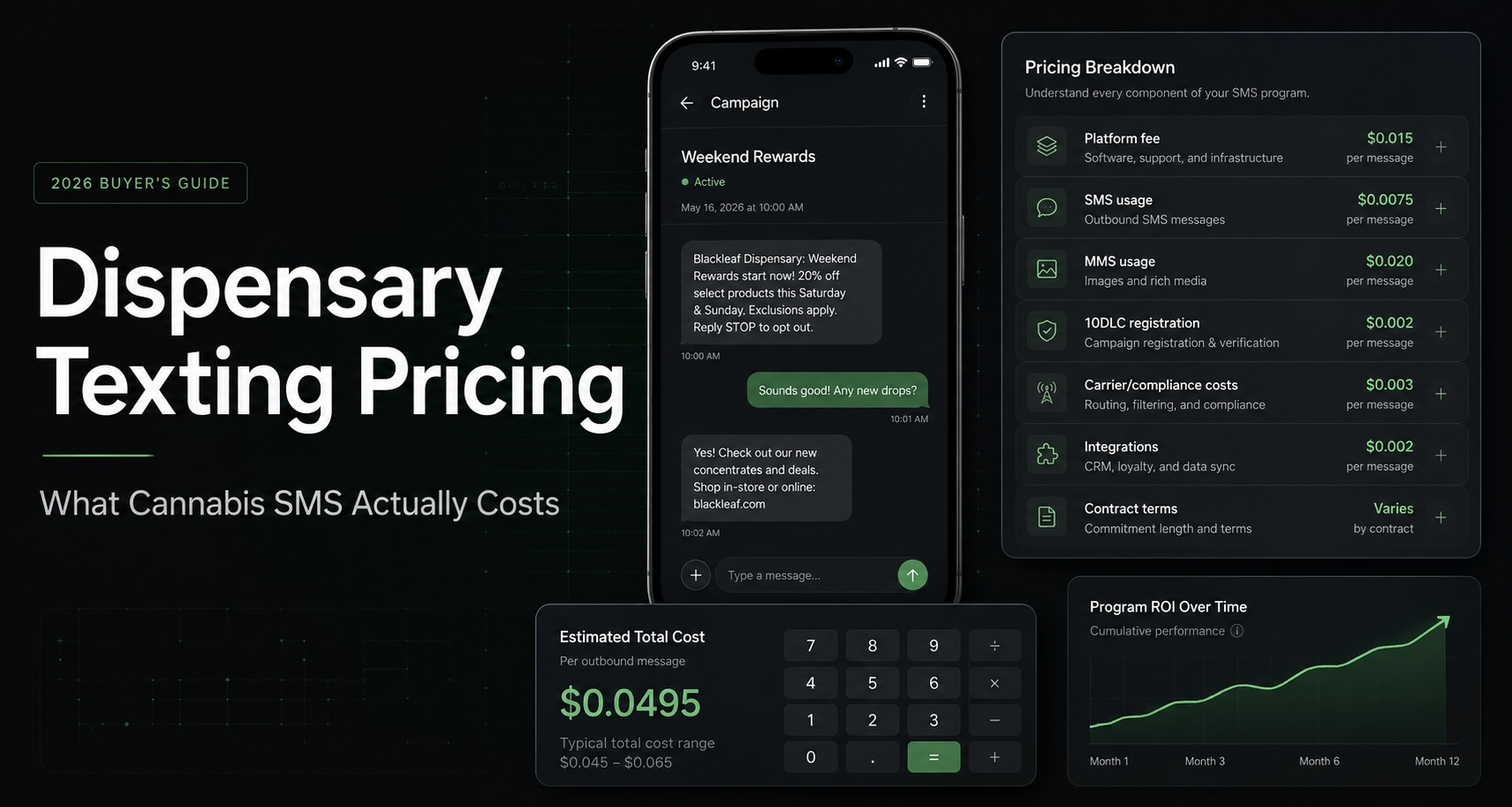
- How Much Does a Dispensary Texting Platform Cost?
- The Main Costs in Dispensary Text Messaging
- SMS Pricing Is Usually Based on Segments
- How to Calculate Your True Monthly SMS Cost
- Example Dispensary Texting Budget
- Current Blackleaf Pricing
- Why the Cheapest SMS Rate May Not Be the Lowest-Cost Platform
- How to Compare Dispensary SMS Proposals
- What Should a Dispensary Budget for Text Marketing?
- How to Measure Whether the Platform Is Worth the Cost
- Common Pricing Mistakes
- Compare Total Operating Cost, Not Just Message Rates
- Frequently Asked Questions
- Sources and Further Reading
- Related Blackleaf Resources
How Much Does a Dispensary Texting Platform Cost?
Dispensary texting software can cost anywhere from a modest monthly platform fee plus usage to a larger custom software contract covering messaging, loyalty, ecommerce, mobile apps and customer data.
The real monthly cost is rarely just the price shown beside an SMS rate. A complete estimate may include the software subscription, SMS segments, MMS messages, registration, carrier or compliance charges, phone numbers, integrations, onboarding, support, locations and contract obligations.
The best way to compare platforms is to calculate the cost of the exact program your dispensary expects to run, then compare that total with the operational and revenue outcomes the platform can realistically support.
The Main Costs in Dispensary Text Messaging
Most dispensary SMS proposals combine several different charges. Some are obvious before purchase, while others become visible only after the first invoice or implementation call.
The recurring fee for access to the software. It may be billed monthly, quarterly or annually.
Confirm which features are included at each level, especially segmentation, automations, POS synchronization, APIs, inbox access, multiple locations and reporting.
SMS is generally charged according to the number of message segments sent, not simply the number of campaigns created.
A campaign sent to 10,000 contacts can therefore create more than 10,000 billable SMS units when the message uses multiple segments.
MMS supports images and richer creative. It usually has a different rate from SMS and may be more expensive per recipient.
Operators should use MMS when the image materially improves the communication, not merely because an image can be attached.
Some vendors include carrier-related charges within the advertised message rate. Others add them separately.
Ask whether the quoted rate is the final usage rate or whether additional carrier, regulatory, compliance or pass-through fees appear on the invoice.
Business texting over a 10-digit long code generally requires the sender’s brand and messaging campaign to be registered through the messaging ecosystem.
A provider may charge for registration, vetting, campaign submission, resubmission or ongoing campaign maintenance.
Some platforms charge for each sender number, store, brand, department or geographic market.
A price that appears reasonable for one store can change substantially when multiplied across a multi-location group.
POS synchronization may be included, sold as an add-on or limited to higher plans.
Confirm the exact systems supported, fields synchronized, update frequency, implementation cost and whether custom development is required.
Implementation may include registration, data import, consent cleanup, template creation, automation setup, training or dedicated account management.
Ask whether those services are included, optional or mandatory.
An annual agreement can create a much larger effective cost than a month-to-month platform, even when the quoted monthly rate appears similar.
Review renewal periods, cancellation windows, minimum usage, early-termination obligations and data-export terms.
SMS Pricing Is Usually Based on Segments
An SMS displayed as one message on a customer’s phone may be transmitted and billed as multiple message segments.
A standard GSM-7 SMS can contain up to 160 characters when it fits within one segment. When a longer GSM-7 message is divided into multiple segments, each segment generally holds fewer characters because part of the message is used to tell the phone how to reassemble it.
Characters outside the GSM-7 character set can cause the message to use Unicode encoding. That may reduce the capacity of a single segment to approximately 70 characters. Emojis, smart quotation marks, certain accented characters and special punctuation can therefore increase the number of billable segments.
| Message format | Typical single-segment capacity | Typical concatenated-segment capacity | Pricing effect |
|---|---|---|---|
| GSM-7 SMS | Up to 160 characters | Approximately 153 characters per segment | A message longer than one segment creates multiple billable units |
| Unicode or UCS-2 SMS | Up to approximately 70 characters | Approximately 67 characters per segment | An emoji or special character can increase the segment count |
| MMS | Varies by provider and carrier | Usually priced as MMS rather than standard SMS segments | Typically has a higher per-recipient rate than SMS |
Pricing mistake to avoid: Do not estimate a campaign by multiplying the number of recipients by the advertised SMS rate until you know how many segments the actual message uses.
How to Calculate Your True Monthly SMS Cost
Use your expected monthly recipient count, average segment count and expected MMS volume. Do not use campaign count alone.
Example Dispensary Texting Budget
Consider a dispensary expecting to send:
5,000 SMS segments per month
1,000 MMS messages per month
One platform subscription
No separate carrier charge
A 10% usage-based compliance fee
Using Blackleaf’s current Business pricing, the illustrative monthly calculation would be:
This example excludes the one-time 10DLC registration charge and assumes every SMS recipient uses one billable segment.
The same recipient volume could cost more if messages use multiple segments, if MMS volume rises or if another provider charges separately for carrier fees, locations, numbers, integrations or support.
Current Blackleaf Pricing
Blackleaf currently publishes three plans. Pricing can change, so buyers should confirm the current rates on the official pricing page before purchasing.
Basic
$29 per month
SMS: $0.05
MMS: $0.07
Includes unlimited contacts, bulk SMS and MMS, a custom landing page, inbox, email support and full API access.
Current 10DLC registration: $99.
Business
$99 per month
SMS: $0.03
MMS: $0.05
Includes advanced segmentation, priority support, automations and point-of-sale synchronization.
Current 10DLC registration: $49.
Enterprise
$199 per month, billed quarterly
SMS: $0.02
MMS: $0.04
Includes rewards and ecommerce website tools, rewards applications for Android and iOS, and unlimited push notifications.
Current 10DLC registration: included.
Current Blackleaf disclosures: Carrier fees are included in the published per-SMS and per-MMS rates. A 10% compliance fee applies to SMS and MMS usage. Current published plans do not require a long-term contract and can be canceled at any time.
Why the Cheapest SMS Rate May Not Be the Lowest-Cost Platform
A low advertised message rate can be attractive, but it does not reveal the complete financial or operational impact of the platform.
Sending to Unengaged Contacts
A cheap rate does not create value when the platform makes it difficult to suppress unengaged, invalid or inappropriate recipients.
Manual Operational Work
Exporting lists, cleaning spreadsheets, rebuilding segments and checking multiple inboxes can cost more in employee time than the message-rate difference.
Incomplete POS Data
An integration label has limited value when the connection cannot support the fields, timing or events required by the campaign.
Unused Software Commitments
A platform can become expensive when the dispensary is locked into unused features, locations or message minimums.
Missing Replies
An outbound-only system can create hidden customer-service costs when questions and order problems are not routed to employees.
Paying for Poorly Executed Sends
Low-quality consent, excessive frequency, unsuitable content and poor list management can reduce the value of every message regardless of the quoted rate.
How to Compare Dispensary SMS Proposals
Ask every provider to price the same operating scenario. Give each vendor the same number of locations, contacts, monthly segments, MMS volume, users, phone numbers, integrations and required workflows.
| Question | Why it matters | What to request in writing |
|---|---|---|
| Is SMS billed per recipient or per segment? | Long or Unicode messages may create multiple billable units | The exact segment-billing policy and a segment preview |
| Are carrier fees included? | An advertised rate may not represent the final usage cost | Every pass-through or percentage charge |
| How is MMS billed? | Creative campaigns can substantially alter the monthly total | The complete MMS rate and media limitations |
| What does registration cost? | Brand and campaign registration may create initial and recurring fees | Registration, vetting, resubmission and maintenance charges |
| Are integrations included? | POS or ecommerce connectivity may require a higher plan | Supported systems, fields, timing and implementation cost |
| Are locations priced separately? | A multi-store rollout may cost much more than a single-store quote | Per-location, number, user and account charges |
| Is API access included? | Custom workflows may otherwise require another package | API limits, webhook support and development charges |
| Is support included? | Registration and delivery problems can require specialized help | Support channels, hours, response targets and account-management fees |
| What is the required contract term? | The total commitment may matter more than the monthly rate | Term, renewal, cancellation window and early-termination language |
| Can all customer data be exported? | Data lock-in can increase the cost of changing providers | Export formats, consent records, conversation history and number-porting terms |
What Should a Dispensary Budget for Text Marketing?
A useful budget begins with the store’s actual messaging strategy rather than an arbitrary number of monthly sends.
Small or New Programs
A smaller store may begin with a focused monthly platform, controlled campaigns, a shared inbox and a carefully maintained list. The priority should be learning which communications produce useful customer actions before increasing volume.
Growing Dispensaries
A growing operator may need purchase-based segments, automated winbacks, birthday flows, POS synchronization, order alerts and more formal reply management. The platform fee may rise, but automation and cleaner targeting can reduce manual work.
Multi-Location Groups
Multi-location pricing should account for store permissions, shared suppression rules, location-specific audiences, centralized reporting, reply assignment, multiple numbers, integration complexity and the risk of contacting the same customer too frequently across stores.
Enterprise Programs
Enterprise buyers may compare messaging as part of a broader package involving loyalty, ecommerce, mobile applications, customer-data tools, analytics and managed services. They should separate the cost and value of each category instead of treating every bundled feature as a texting expense.
How to Measure Whether the Platform Is Worth the Cost
The least expensive invoice is not necessarily the best financial outcome. Evaluate the platform against measurable business and operational results.
Revenue attributed to each campaign
Revenue per SMS segment sent
Repeat-visit rate after messaging
Winback conversion among lapsed customers
Order-completion rate after pickup alerts
Opt-out and complaint rate
Customer-reply response time
Employee hours spent preparing campaigns
Cost per recovered or repeat customer
Contact-list growth and retention
Attribution limitation: Revenue measurement depends on the POS, ecommerce and customer data available to the messaging platform. Ask vendors to demonstrate the exact attribution method rather than relying on a generic ROI claim.
Common Pricing Mistakes
Comparing only the per-SMS rate. The platform fee, MMS, registration, compliance charges, integrations and contract term may matter more.
Assuming one campaign recipient equals one billable SMS. Long or Unicode messages may use multiple segments.
Ignoring contract exposure. Multiply the full required term rather than evaluating only one month.
Buying features before defining the workflow. A large bundle is not valuable when employees cannot implement it.
Failing to price every location. Per-store, number and integration charges can change the total substantially.
Ignoring data portability. Rebuilding lists, consent history and automations after a difficult migration has a real cost.
Choosing volume over relevance. Sending more messages does not automatically produce better results.
Using creative characters without checking segments. An emoji or smart punctuation can unexpectedly change message encoding.
Compare Total Operating Cost, Not Just Message Rates
The true cost of dispensary texting includes software, segments, MMS, registration, carrier or compliance charges, integrations, support, employee time and contract risk.
A strong proposal should make those components understandable before the dispensary signs. It should also give the operator enough control to manage audience quality, message length, frequency, replies and performance.
Blackleaf is designed for operators that want published pricing, flexible plans and a focused path from basic campaigns to segmentation, automations, POS synchronization, rewards and ecommerce tools.
Frequently Asked Questions
How much does dispensary text marketing cost?
The total depends on the platform subscription, SMS segment volume, MMS volume, registration, carrier or compliance charges, integrations, locations, support and contract terms. Buyers should calculate their expected operating scenario rather than relying on the advertised message rate alone.
Is an SMS charged once per recipient?
Not always. SMS is commonly priced by message segment. A long message or one containing Unicode characters may create multiple billable segments for each recipient.
Why did one text cost more than expected?
The message may have exceeded one segment or included an emoji, smart quotation mark, special punctuation or another character that changed its encoding. That can reduce the number of characters available in each segment.
Is MMS more expensive than SMS?
MMS generally has a different and often higher per-recipient rate because it supports images and multimedia. Confirm the provider’s exact MMS rate and media limitations.
Are carrier fees included in dispensary SMS pricing?
It depends on the provider. Some include carrier-related charges in the published usage rate, while others add pass-through fees separately. Request a complete fee schedule in writing.
What is a 10DLC registration fee?
10DLC registration helps identify the business sending application-to-person messages and the campaign or use case being operated. A messaging provider may charge for registration, vetting, submission or ongoing maintenance.
Does Blackleaf include carrier fees?
Blackleaf’s current public pricing states that carrier fees are included in its per-SMS and per-MMS rates. A 10% compliance fee currently applies to SMS and MMS usage.
Does Blackleaf require an annual contract?
Blackleaf’s current published plans do not require a long-term contract. Customers can cancel at any time under the published terms.
What is Blackleaf’s least expensive plan?
Blackleaf currently publishes a Basic plan at $29 per month, plus messaging usage and applicable fees. It includes unlimited contacts, bulk SMS and MMS, a landing page, inbox, support and API access.
How should a multi-location dispensary compare pricing?
Price the complete group, including locations, numbers, users, contacts, integrations, permissions, reply routing, reporting and expected message volume. Also confirm whether customers shared between locations are protected from excessive contact frequency.
Should a dispensary choose the platform with the lowest SMS rate?
Not automatically. The lowest rate may not produce the lowest operating cost when the product requires additional fees, manual employee work, a long contract or weak integrations. Compare total cost and demonstrated operational fit.
Sources and Further Reading
Pricing and product features can change. Review the vendor’s current proposal and terms before purchasing. This article provides general business information and does not constitute legal advice.