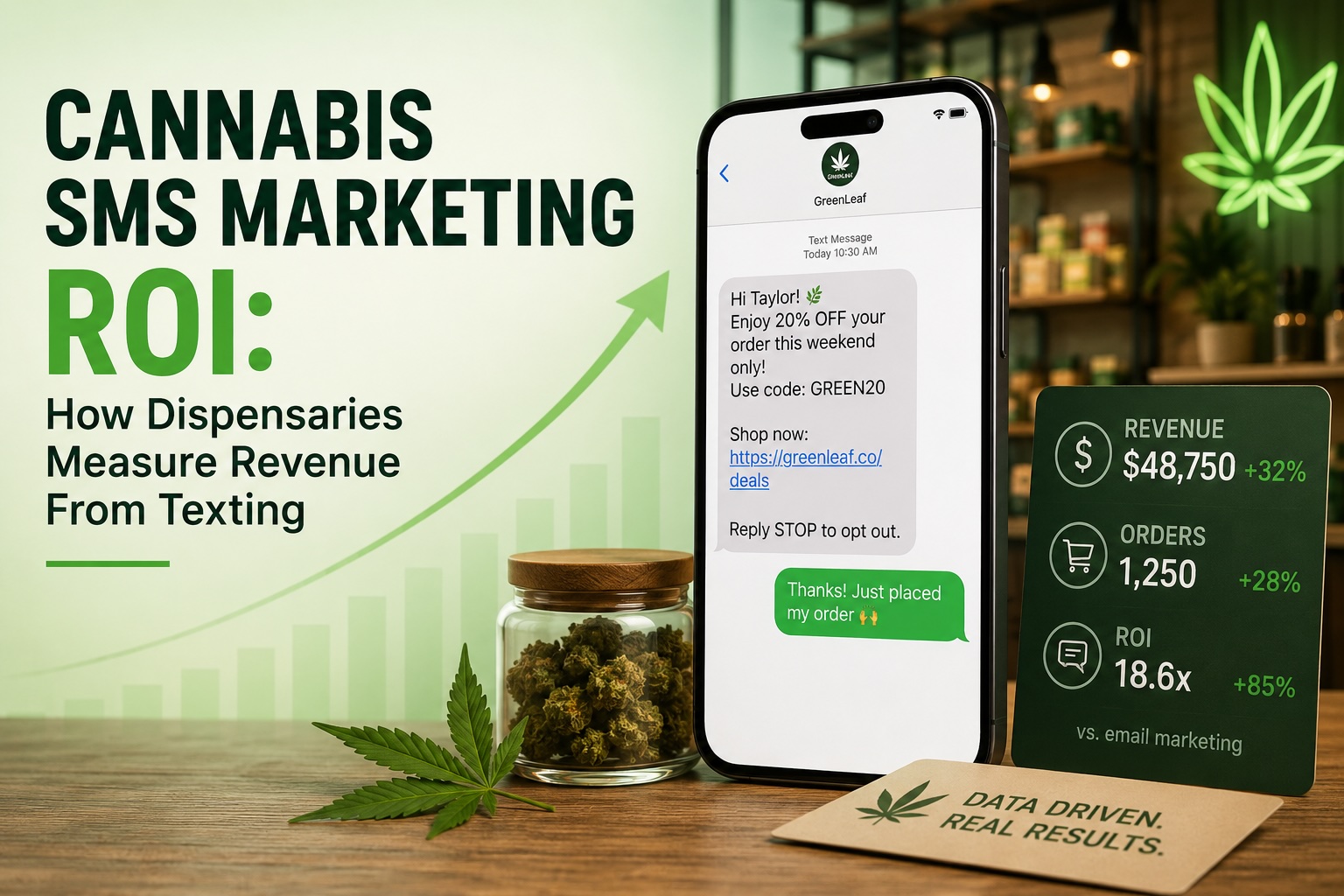
Cannabis SMS marketing ROI measures the financial return generated by dispensary text messaging after subtracting the complete cost of the program. The most useful calculation compares incremental gross profit, not total sales, with message costs, software fees, campaign labor, promotional expense, and other directly associated costs. Strong measurement also uses a defined attribution window and, when possible, a holdout or comparison group.
A dispensary can send a text campaign, observe a large amount of sales, and still misunderstand whether the message was profitable.
Customers may have purchased without receiving the text. Some attributed revenue may come from regular shoppers who were already planning to visit. A promotion can produce more sales while reducing gross profit. A campaign can also look inexpensive when the calculation includes the message rate but excludes the software fee, staff time, discount expense, or cost of the products used in the offer.
Measuring cannabis SMS marketing ROI requires a disciplined answer to three questions:
- What did the dispensary spend?
- What customer behavior changed because of the message?
- How much incremental gross profit did that change produce?
This guide provides a practical framework for answering those questions without relying only on clicks, reported revenue, or inflated return figures.
What is cannabis SMS marketing ROI?
Cannabis SMS marketing ROI is the percentage return a dispensary generates from its text messaging investment after accounting for the complete campaign cost and the incremental financial value produced by the message.
ROI is not the same as revenue attribution.
Revenue attribution estimates how much customer spending should be connected with a campaign. ROI goes further by comparing the financial benefit of that spending with the complete cost required to produce it.
A campaign can therefore have:
- High attributed revenue but weak profit
- A strong click rate but low purchase conversion
- Many redemptions but little incremental behavior
- A low message cost but an expensive discount
- A positive short-term return but excessive long-term opt-outs
A credible ROI framework should separate those outcomes instead of combining them into one impressive-looking number.
The cannabis SMS marketing ROI formula
This formula evaluates the return after product cost and campaign expense. It is more financially useful than dividing total attributed revenue by the cost of the text messages.
The formula contains two important concepts:
- Incremental gross profit: the additional gross profit that likely would not have occurred without the campaign.
- Campaign cost: the complete cost of sending and operating the campaign, not only the per-message charge.
A simpler return-on-spend calculation
Some dispensaries also track revenue return on messaging spend:
This can be useful for comparing campaigns, but it is not the same as profit-based ROI because it does not account for product cost, discount expense, or whether the revenue was incremental.
A campaign that reports $10 in attributed revenue for every $1 of message cost does not automatically have a 900% financial ROI. The attributed sales still include cost of goods, taxes where applicable, discounts, normal customer spending, and other campaign expenses.
How to calculate the complete cost of a text campaign
The cost of a cannabis SMS campaign can extend beyond the number of recipients multiplied by an advertised SMS rate.
Depending on the provider and campaign, the complete cost may include:
Message usage
Outbound SMS segments, MMS messages, inbound messages, carrier charges, and other usage-based costs.
Platform expense
The portion of the monthly software fee reasonably assigned to the campaign or measurement period.
Registration and infrastructure
Sender registration, phone numbers, compliance charges, integrations, data synchronization, and related services.
Labor and creative
Time spent selecting the audience, writing the message, creating media, reviewing the campaign, and analyzing results.
Promotional expense
The margin lost through discounts, promotional pricing, giveaways, reward credits, or subsidized products.
Landing-page and integration costs
Campaign pages, tracked links, ecommerce changes, outside agency work, or technical support needed for measurement.
Allocating fixed monthly costs
A monthly software fee supports more than one campaign. A dispensary can allocate the fee by campaign count, message volume, store location, or another consistent method.
For example, a store that sends four major campaigns in one month might allocate one-quarter of the monthly platform fee to each campaign. A high-volume operator may prefer to allocate the fee based on the share of total monthly messages used by each campaign.
The exact approach matters less than applying it consistently. Changing the allocation method from campaign to campaign makes performance comparisons unreliable.
Account for SMS segments
A message displayed as one text in a campaign editor can be billed as multiple SMS segments. Message length and character encoding affect how many segments are transmitted.
A standard GSM-7 SMS can contain up to 160 characters in one segment. Longer GSM-7 messages generally use up to 153 characters per segment. Unicode characters can reduce the limit to 70 characters for one segment or 67 characters per segment in a multi-part message.
Emoji, smart quotation marks, and other Unicode characters may therefore increase campaign cost without making the visible message appear much longer.
For a complete cost breakdown, read Dispensary Texting Pricing: What Cannabis SMS Actually Costs .
Attributed revenue versus incremental revenue
The difference between attributed and incremental revenue is one of the most important concepts in cannabis SMS measurement.
| Measurement | What it represents | Primary strength | Primary limitation |
|---|---|---|---|
| Attributed revenue | Revenue connected with recipients who purchased during the selected attribution window. | Relatively easy to calculate when customer and sales data are connected. | May include customers who would have purchased without the message. |
| Incremental revenue | Revenue above the amount expected without the campaign. | Better estimates the change caused by the campaign. | Requires a baseline, comparison group, or statistical assumption. |
| Attributed gross profit | Gross profit generated by attributed transactions. | Accounts for product cost. | Can still include purchases that were not caused by the campaign. |
| Incremental gross profit | Additional gross profit likely caused by the campaign. | Best financial input for a rigorous ROI calculation. | Requires stronger measurement design and reliable margin data. |
Why attributed revenue is usually higher
Imagine that 1,000 customers receive a message and 100 of them purchase within three days. It would be easy to attribute all 100 transactions to the campaign.
However, some of those customers shop every week. Others may have already placed an order, planned a weekend visit, or responded to another marketing channel. The campaign may have influenced some purchases without causing every purchase.
Attributed revenue answers:
“How much did recipients spend after receiving the message?”
Incremental revenue attempts to answer:
“How much additional spending occurred because recipients received the message?”
Attributed revenue remains useful. The mistake is presenting it as proof that every included transaction was caused by the campaign. Use attributed revenue for operational reporting and incremental revenue for stronger financial evaluation.
Why dispensary SMS ROI should use gross profit
Revenue is not profit. A campaign that generates $10,000 in sales does not give the dispensary $10,000 to recover its marketing cost.
The products sold have acquisition cost. The offer may include a discount. Taxes and fees may be reported differently across systems. Additional labor or fulfillment expenses may also change.
A practical calculation begins with:
Net sales should reflect discounts and the accounting treatment used by the dispensary. Taxes collected for a government agency are generally not operating revenue and should not inflate campaign performance.
Promotions can increase revenue while reducing return
Consider two campaigns:
- Campaign A generates $8,000 in sales with a modest incentive and $3,200 in gross profit.
- Campaign B generates $10,000 in sales with a deep discount but only $2,700 in gross profit.
Campaign B appears stronger when ranked by revenue. Campaign A may be financially better after product cost and promotional expense.
The dispensary should therefore evaluate both customer response and margin quality.
How to choose an SMS attribution window
An attribution window is the period after a message during which an eligible customer purchase may be connected with the campaign.
A same-day promotion might justify a short window. A customer win-back flow may require several days. A review request should be measured using review behavior rather than purchase revenue. An order notification should be evaluated through pickup completion and customer support outcomes.
Questions for selecting the window
- When does the offer or campaign expire?
- How frequently do customers normally shop?
- How long does it usually take recipients to act?
- Could another campaign reach the same customer during the window?
- Is the message intended to drive an immediate or delayed response?
- Can online and in-store purchases be matched consistently?
A long attribution window captures more transactions, but it also increases the chance of claiming purchases that would have occurred without the message. Choose the window before reviewing campaign results rather than extending it until the revenue looks impressive.
Use the same window when comparing campaigns
A one-day campaign and a seven-day campaign cannot be compared fairly when both are reported as simple attributed revenue. Normalize the measurement period or clearly explain why the windows differ.
Using holdout groups to estimate incremental lift
A holdout group is a portion of an eligible audience that does not receive the campaign. The dispensary compares the purchase behavior of the messaged group with the behavior of the holdout group.
This helps estimate how much activity might have occurred without the message.
Basic holdout calculation
The difference can be applied to the number of messaged customers to estimate incremental transactions, revenue, or gross profit.
Example
Suppose the messaged audience converts at 8% and the holdout audience converts at 5% during the same period.
The estimated incremental lift is 3 percentage points. If 10,000 eligible customers received the campaign, that difference represents an estimated 300 incremental transactions.
The dispensary can then apply actual average net sales and gross profit per transaction to estimate incremental financial value.
What makes a holdout useful?
- The holdout should be selected before the campaign is sent.
- The two groups should be reasonably comparable.
- Both groups should be measured during the same period.
- The holdout should not receive a similar campaign through another flow.
- The sample should be large enough to reduce random variation.
- Store, geography, loyalty status, and customer activity should be considered.
A holdout does not eliminate every measurement problem, but it is usually more informative than assigning every post-send purchase to the message.
Cannabis SMS revenue measurement methods
No single attribution method captures every customer journey. Many dispensaries use several methods together.
| Method | How it works | Best use | Limitation |
|---|---|---|---|
| Tracked links | A unique campaign link records visits and downstream online activity. | Online ordering, landing pages, menu visits, and forms. | Misses customers who read the message but do not click. |
| Offer codes | A campaign-specific code is recorded during checkout. | Promotions with clear redemption rules. | Staff may forget the code or customers may share it. |
| Customer matching | Recipients are matched with customer records and purchases inside a defined window. | Connected POS and customer-data environments. | Can overattribute normal purchases. |
| Holdout testing | Behavior is compared between messaged and non-messaged eligible customers. | Estimating incremental conversion and revenue. | Requires audience size, clean execution, and patience. |
| Period comparison | Campaign performance is compared with a prior or typical period. | Operators without a usable holdout group. | Seasonality and outside changes can distort the result. |
| Product or category lift | Sales of promoted products are compared with their normal baseline. | Product-specific promotions and vendor campaigns. | Inventory, placement, pricing, and other promotions can affect sales. |
| Customer lifecycle analysis | Visit frequency or retention is compared before and after joining or receiving a messaging program. | Win-back, loyalty, and long-term retention measurement. | Requires longer time periods and careful comparison. |
Clicks are supporting evidence
Clicks show that recipients interacted with a link. They are useful for diagnosing message interest, landing-page traffic, and differences between audiences.
They do not prove that the campaign produced profitable purchases. A low-click campaign can still drive in-store traffic, and a high-click campaign can lead to few transactions.
Redemption codes are not perfect attribution
A unique code can create a strong connection between the message and the transaction, but codes can be shared, entered incorrectly, or omitted by store staff.
Code use is strongest when supported by recipient matching, purchase timing, and a clearly defined campaign audience.
Worked cannabis SMS ROI example
Weekend customer reactivation campaign
This example is illustrative and does not represent a Blackleaf customer result.
A 2.5-percentage-point lift across 10,800 messaged customers produces an estimated 270 incremental transactions.
Assume those transactions produced average net sales of $52 and average gross profit of $20.80 per transaction.
The estimated net incremental return is:
$5,616 incremental gross profit − $600 campaign cost = $5,016
The estimated ROI is:
($5,016 ÷ $600) × 100 = 836%
The 836% figure is a profit-based estimate supported by the holdout difference. Reporting all sales made by messaged customers would produce a much larger number, but it would also include normal purchases that occurred in the holdout group.
What the example still does not prove
Even a holdout-based result should be interpreted carefully. Random customer differences, store conditions, inventory changes, weather, paydays, competitor promotions, and other factors may affect behavior.
Repeated tests are more valuable than one unusually strong campaign. The objective is to build a consistent measurement process, not to find the largest possible ROI number.
How to measure different dispensary SMS campaign types
Not every message should be judged by immediate sales. The correct metric depends on the message’s purpose.
| Message type | Primary outcome | Supporting metrics | ROI consideration |
|---|---|---|---|
| Promotional campaign | Incremental transactions and gross profit | Clicks, redemptions, average ticket, opt-outs | Subtract discount and promotional expense |
| Customer win-back | Reactivated customers and repeat gross profit | Time since prior visit, second return, offer use | Measure whether customers remain active after redemption |
| Order notification | Pickup completion and operational efficiency | Support contacts, wait time, canceled orders | Value can include labor saved and abandoned orders reduced |
| Review request | Completed customer reviews and feedback | Clicks, age-gate completion, rating trends | Do not force an artificial same-day revenue calculation |
| Birthday automation | Birthday-period visits and incremental gross profit | Redemption, average ticket, repeat visit after birthday | Include the cost of the birthday benefit |
| Loyalty reminder | Reward use and customer retention | Points redeemed, return timing, purchase frequency | Separate reward liability from incremental customer value |
| Two-way support | Customer resolution and completed purchases | Response time, resolution rate, avoided calls | Value may include labor efficiency and saved transactions |
Measure automation over a longer period
A scheduled campaign has a clear send date. An automation operates continuously as customers enter and exit the flow.
Automation reporting should use consistent monthly or quarterly cohorts. Compare eligible customers who received the flow with similar customers who did not, and examine behavior beyond the first discounted purchase.
For automation ideas, review SMS Automation Flows for Dispensaries .
Metrics that support cannabis SMS ROI
ROI is a final financial outcome. Supporting metrics help explain why the result improved or declined.
How many intended recipients reached a confirmed or usable delivery state?
How much campaign expense was incurred for messages that reached the audience?
How many delivered recipients interacted with the campaign link?
What portion of the eligible audience completed the intended action?
How much more frequently did the messaged group convert than the comparison group?
How much revenue remained after campaign discounts and applicable adjustments?
How much attributed or incremental profit remained after product cost?
How much future audience access was lost after the campaign?
Did acquired or reactivated customers return again without the same incentive?
Revenue per recipient
Revenue per recipient normalizes results across campaigns of different sizes:
Incremental gross profit per recipient is a stronger financial version when the necessary comparison and margin data are available.
Cost per incremental transaction
This metric helps compare SMS with other channels and with the gross profit produced by each incremental transaction.
Opt-outs are an economic cost
An opt-out does not create an immediate invoice, but it removes the ability to communicate with that customer through future marketing messages unless the person later provides valid new consent.
A campaign that produces short-term revenue and unusually high opt-outs may be borrowing against future performance. Track opt-out behavior by campaign, audience, frequency, offer type, and signup source.
Common dispensary SMS ROI measurement mistakes
Calling all post-send sales campaign revenue
This is the most common attribution error. Regular customers would have produced some sales without the message. Use a holdout, baseline, or clearly disclosed attribution method.
Using revenue instead of gross profit
Revenue ignores product cost and can reward campaigns that generate large sales totals through weak-margin offers.
Ignoring the cost of the discount
A campaign with a deep discount may look successful when the calculation counts the message fee but excludes the margin surrendered through the offer.
Counting only the advertised SMS rate
The complete cost may include multiple segments, MMS, platform fees, registration, compliance charges, labor, creative work, and technical expense.
Changing the attribution window after seeing results
Choosing the window after reviewing revenue introduces bias. Establish the window before the campaign and use consistent rules.
Comparing unlike campaigns
A customer win-back campaign should not be compared directly with an order notification or broad holiday promotion without accounting for audience, objective, offer, duration, and margin.
Ignoring customers who received overlapping messages
A person may receive a campaign, birthday automation, loyalty reminder, and order notification within the same attribution window. Determine how credit will be assigned before reporting the result.
Reporting a percentage without the underlying values
A large ROI percentage can result from a very small campaign cost. Report campaign cost, incremental gross profit, audience size, and measurement method alongside the percentage.
Using one successful campaign as a permanent benchmark
Performance changes with seasonality, list quality, store conditions, customer fatigue, inventory, competition, and promotional strategy. Evaluate repeated campaigns and rolling trends.
How to build a repeatable dispensary SMS ROI process
Define the campaign objective
Choose one primary outcome, such as incremental transactions, customer reactivation, review completion, order pickup, or repeat visits.
Document the eligible audience
Record who qualified, who was excluded, the relevant store or location, and the audience size before sending.
Choose the measurement method
Select tracked links, customer matching, offer codes, holdout testing, period comparison, or a combination.
Set the attribution window
Choose the period based on the campaign purpose and expiration before reviewing performance.
Calculate complete campaign cost
Include usage, platform allocation, labor, creative, promotional expense, and directly related technical costs.
Collect net sales and margin data
Use transaction data that accounts for discounts and product cost instead of relying only on gross register totals.
Estimate incremental performance
Compare the messaged audience with a holdout, prior behavior, normal baseline, or another documented comparison.
Review supporting metrics
Use delivery, clicks, opt-outs, average ticket, product mix, and repeat behavior to explain the financial result.
Save the methodology with the report
Document the formulas, exclusions, assumptions, and data sources so future campaigns can be compared fairly.
Pre-send ROI measurement checklist
- One primary campaign objective is defined.
- The eligible audience is saved.
- The holdout or comparison method is selected.
- The attribution window is documented.
- The offer cost and margin effect are understood.
- Tracked links or offer codes are tested.
- POS and customer data can be matched.
- Overlapping campaigns are identified.
- The complete message cost is estimated.
- Success and failure thresholds are established.
How Blackleaf supports dispensary SMS measurement
Blackleaf is built for dispensary text messaging across promotional campaigns, audience segmentation, automated customer journeys, two-way conversations, order alerts, and performance reporting.
Connecting messaging activity with customer and point-of-sale data can help operators move beyond basic click reporting and examine revenue per send, customer behavior, and repeat visits.
The software cannot decide which attribution assumptions are appropriate for every business. Dispensaries still need to define campaign purpose, measurement windows, cost treatment, margin methodology, and the meaning of an incremental result.
Explore Blackleaf’s dispensary text messaging platform or review the complete guide to cannabis SMS marketing .
Frequently asked questions
What is cannabis SMS marketing ROI?
Cannabis SMS marketing ROI measures the financial return produced by dispensary text messaging after accounting for complete campaign costs. A rigorous calculation compares incremental gross profit with message usage, platform expense, labor, promotional cost, and other directly associated expenses.
How do dispensaries calculate SMS marketing ROI?
A practical formula is: ((incremental gross profit minus campaign cost) divided by campaign cost) multiplied by 100. Dispensaries should define the attribution window, calculate complete campaign cost, estimate incremental customer behavior, and use gross profit rather than total sales.
What is the difference between attributed revenue and incremental revenue?
Attributed revenue is spending connected with customers who purchased after receiving a message. Incremental revenue is the additional spending estimated to have occurred because of the message. Attributed revenue is easier to calculate but can include purchases that would have happened anyway.
Should dispensary SMS ROI use revenue or profit?
Profit provides the stronger financial measure. Revenue does not account for product cost, campaign discounts, promotional expense, or other costs. Incremental gross profit is generally a more useful input for ROI than total attributed revenue.
What costs should be included in dispensary SMS ROI?
Costs may include SMS segments, MMS messages, platform fees, registration, carrier or compliance charges, phone numbers, integrations, campaign labor, creative work, landing pages, discount expense, rewards, and other directly related costs.
What is an SMS attribution window?
An SMS attribution window is the period after a message during which eligible customer activity may be connected with the campaign. The window should be selected before results are reviewed and should reflect the campaign purpose, expiration, and normal customer purchase cycle.
What is a holdout group in dispensary SMS marketing?
A holdout group is a portion of an eligible audience that does not receive the message. Comparing its purchase behavior with the messaged audience helps estimate incremental conversion, revenue, and gross profit.
Are clicks enough to measure dispensary texting performance?
No. Clicks show interaction with a link but do not prove that the campaign produced a purchase or profit. They should be evaluated alongside transactions, gross profit, incremental lift, opt-outs, and repeat customer behavior.
How should dispensaries measure customer win-back texts?
Measure reactivated customers, incremental purchases, gross profit, redemption cost, and whether customers return again after the initial win-back purchase. A holdout of similarly inactive customers can provide a stronger baseline.
Can a campaign have high revenue and negative ROI?
Yes. A campaign may generate substantial sales while producing insufficient gross profit to cover message costs, labor, discounts, product cost, and promotional expense. Revenue alone does not establish profitability.
What is a good cannabis SMS marketing ROI?
There is no universal number. A useful target depends on the dispensary’s margins, campaign objective, customer segment, promotional cost, attribution method, and alternative uses of the marketing budget. Consistency and transparent methodology are more important than comparing an unsupported headline percentage.
Measure more than clicks after your next dispensary text campaign
Blackleaf helps dispensaries run targeted campaigns, automate customer communication, connect messaging with retail data, and evaluate revenue and repeat customer behavior through one cannabis-friendly texting platform.
Talk to BlackleafTechnical note: SMS segment limits vary by character encoding. Standard GSM-7 messages support up to 160 characters in one segment, while multi-part GSM-7 messages generally use 153 characters per segment. UCS-2 messages generally support 70 characters in one segment or 67 characters per segment when concatenated.
This article is provided for general educational and operational purposes. It is not accounting, tax, financial, or legal advice. Dispensaries should work with qualified professionals when establishing their accounting treatment, margin calculations, tax reporting, attribution methodology, and regulatory practices.