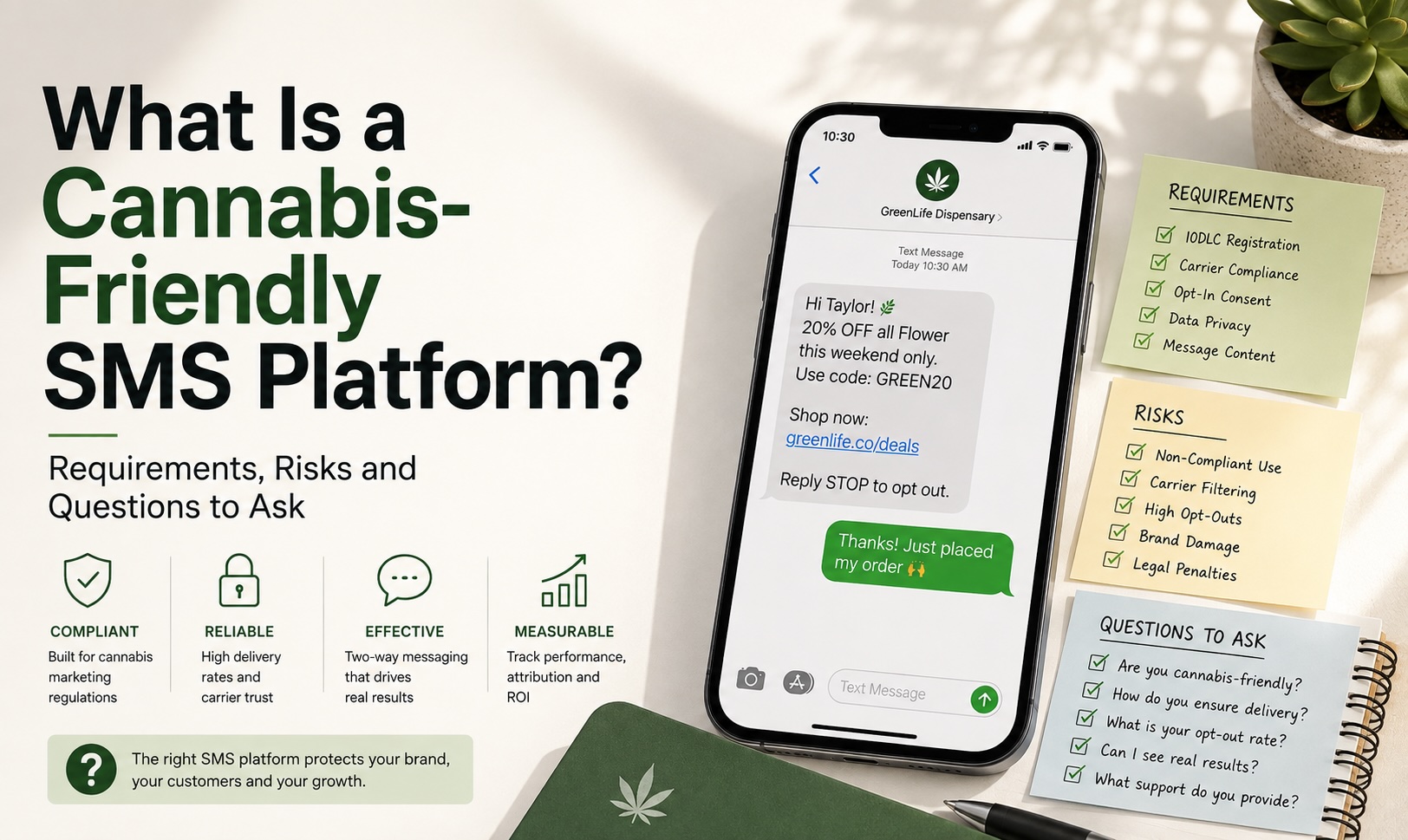
A cannabis-friendly SMS platform is a messaging provider that knowingly accepts eligible cannabis businesses and supports their actual use case through transparent registration, consent management, age controls, opt-out handling, deliverability reporting, and regulated-industry support. A platform is not truly cannabis-friendly if the software allows signup while an undisclosed downstream provider prohibits the traffic.
Choosing an SMS platform is more complicated for a dispensary than it is for a conventional retailer.
A software company may allow a cannabis business to create an account, import contacts, and build a campaign while another company involved in transmitting the message applies a more restrictive policy. The account can appear functional until registration is reviewed, campaign volume increases, content is inspected, or a delivery problem requires support.
That is why dispensaries should not evaluate a provider only by its campaign editor, monthly fee, or advertised message rate.
The more important questions are:
- Does the provider knowingly support the cannabis business category?
- Is the intended traffic accurately registered?
- Can the provider explain which responsibilities belong to the dispensary?
- What happens when a message is filtered or rejected?
- Can the dispensary export its customer data and leave without disruption?
This guide explains what a cannabis-friendly SMS provider should include, which warning signs operators should investigate, and which questions to ask before moving a customer list or signing a contract.
What does cannabis-friendly SMS platform mean?
A cannabis-friendly SMS platform knowingly supports licensed dispensaries, cannabis retailers, or eligible cannabis brands and provides messaging workflows designed around the category’s registration, consent, age, deliverability, and operational requirements.
The term should describe actual provider acceptance, not only a marketing claim.
A provider may call itself cannabis-friendly because it has several cannabis customers. That does not necessarily explain:
- Whether the business category was disclosed accurately
- Whether the downstream messaging route knowingly accepts the traffic
- Whether the sender and campaign use case were registered correctly
- Whether promotional cannabis content is supported
- Whether the linked landing pages are reviewed
- What happens when a carrier or vendor policy changes
- Whether support can troubleshoot cannabis-specific problems
A dispensary should ask the provider to explain how its support for cannabis works in practice.
Transparent cannabis support
- The business category is disclosed accurately.
- The intended traffic is documented before sending.
- Consent and age controls are part of setup.
- Delivery failures can be investigated.
- Support understands dispensary operations.
- Pricing and contract terms are visible.
Generic software with unclear acceptance
- The account is opened under a vague business category.
- The provider cannot explain downstream restrictions.
- Support recommends disguising message content.
- Delivery problems are reported only as generic failures.
- Customer data is difficult to export.
- The dispensary is locked into a long contract.
Why cannabis acceptance matters
A dispensary can operate legally under state or local licensing rules and still encounter restrictions from private technology and telecommunications companies.
These companies may establish their own acceptable-use policies, registration standards, risk rules, prohibited-content categories, and account-review procedures.
The result is an important distinction:
Legal business status does not automatically create access to every commercial messaging network. A provider must support the business category and the specific traffic being sent.
When that support is unclear, the dispensary may face:
- Rejected sender or campaign registrations
- Delayed launches
- Messages that fail or are filtered
- Temporary or permanent account restrictions
- Loss of access to a sending number
- Disruption during an important promotional period
- Unexpected migration costs
- Difficulty exporting customer and consent records
Choosing a cannabis-friendly platform does not guarantee that every message will be delivered. It reduces avoidable risk by starting with a provider that understands and accepts the actual business use case.
Core requirements for a cannabis-friendly SMS platform
A strong platform should combine category acceptance with the tools needed to operate a permission-based texting program.
Explicit cannabis acceptance
The provider should knowingly support eligible cannabis businesses instead of relying on incomplete or misleading account information.
Sender registration support
The platform should explain how the business identity, sender, campaign, and intended message use case are registered.
Consent records
The system should store or preserve useful information about how and when customers joined the messaging program.
Opt-out enforcement
STOP requests and other supported opt-out language should prevent future promotional sends to the customer.
Age controls
The platform should support age-appropriate signup and linked customer experiences for a regulated retail category.
Delivery reporting
Operators should be able to distinguish successful delivery, failures, filtering indicators, and customer-level suppression.
Audience segmentation
The dispensary should be able to select relevant customers instead of sending every campaign to the full list.
Data portability
The business should understand how to export contacts, consent data, suppression records, and campaign information.
Sender and campaign registration
Business texting normally requires more than purchasing a phone number and uploading a contact list.
The platform may need information about:
- The legal business entity
- The customer-facing dispensary or brand name
- The business website
- The intended message categories
- The customer signup process
- Sample messages
- Expected message volume
- How customers request help or opt out
- The linked landing-page experience
A cannabis-friendly provider should help the dispensary describe its actual use case accurately. It should not advise the business to register under an unrelated category or submit sample traffic that does not resemble the campaigns it plans to send.
A registration can be approved while later traffic still creates problems if the messages, volume, links, audience, or business use case differ materially from what was submitted. Approval is not a replacement for ongoing operational discipline.
Questions to ask about registration
- Who submits the business and campaign registration?
- Which business information is required?
- Can the dispensary review what is submitted on its behalf?
- What sender type will be used?
- How long does approval normally take?
- What happens if registration is rejected?
- Are registration charges refundable?
- Can the sender be transferred if the dispensary changes platforms?
- How are additional stores or brands registered?
For a deeper explanation, review 10DLC for dispensaries .
Consent, STOP, HELP, and suppression tools
A cannabis-friendly provider should make consent management part of the normal messaging workflow.
The platform should help the operator answer:
- Where did this customer sign up?
- When did the customer provide consent?
- Which dispensary or brand did the customer authorize?
- What type of messages was the customer told to expect?
- Has the customer opted out?
- Was the number later added through another source?
Opt-outs should be enforced across the account
A customer who opts out should not continue receiving promotional campaigns because the number remains in another list, automation, store segment, integration, or imported file.
Suppression should be applied consistently across:
- Scheduled campaigns
- Automations
- Manual sends
- Imported customer lists
- Location-level accounts
- API-triggered messages where applicable
HELP requests need an operational response
A HELP response should identify the sender and provide a useful way for the customer to obtain assistance.
The platform should also make it clear whether customer replies enter a shared inbox, create a support notification, or remain visible only in a campaign report.
Learn more in Blackleaf’s guide to dispensary SMS opt-in and consent .
Age-gating and linked customer experiences
A dispensary SMS program often sends customers to a menu, promotion, reward, review flow, signup page, or other mobile destination.
The linked experience is part of the campaign. Operators should evaluate it as carefully as the message itself.
A cannabis-friendly platform should support:
- Mobile-friendly age controls
- Location-specific landing pages
- Consistent dispensary branding
- Clear offer terms
- Approved link domains
- Fast loading on mobile devices
- Campaign and conversion measurement
An age gate should not be treated as a decorative screen placed in front of every link. The dispensary should understand what the control is intended to accomplish, how customers complete it, what information is recorded, and where customers go afterward.
Explore Blackleaf’s age-gating tools.
Deliverability, filtering, and reporting
No responsible SMS provider can promise that every message will always reach every customer.
Delivery can be affected by invalid numbers, customer devices, carrier policies, sender reputation, registration, traffic patterns, message content, links, list quality, complaints, and other technical conditions.
The provider should therefore offer visibility rather than an absolute guarantee.
Useful deliverability reporting includes:
Attempted messages
How many recipients remained eligible when the send began?
Delivered messages
How many messages reached a delivered or confirmed state?
Failure categories
Can the operator distinguish invalid numbers, blocked traffic, temporary failure, and other outcomes?
Carrier or route patterns
Can support investigate whether failures are concentrated in a specific network, sender, or campaign?
Opt-outs and replies
Did the campaign cause list loss, HELP requests, or customer questions?
Engagement and conversion
Did delivered recipients click, visit, purchase, reply, or take the intended action?
Claims such as “100% deliverability,” “no filtering,” or “every message reaches the customer” should be investigated carefully. Strong platforms reduce avoidable delivery problems and provide visibility when failures occur. They do not control every carrier, device, customer number, or network decision.
Review Blackleaf’s guides to cannabis SMS carrier filtering and SMS deliverability troubleshooting .
Operational features a dispensary should evaluate
Category acceptance is essential, but the platform also needs to support the way a dispensary communicates with customers.
| Feature | Why it matters | What to verify |
|---|---|---|
| Campaigns | Supports scheduled promotional and informational sends | Audience controls, scheduling, previews, approvals, and reporting |
| Segmentation | Reduces irrelevant full-list messaging | Available customer fields, exclusions, location rules, and saved audiences |
| Automations | Creates consistent lifecycle and operational communication | Triggers, delays, exit rules, overlap controls, and suppression |
| Two-way inbox | Allows store teams to handle customer replies | Shared access, assignments, notifications, history, and permissions |
| Order alerts | Keeps customers informed about order status | POS events, duplicate prevention, failed-message handling, and timing |
| Review requests | Turns post-purchase follow-up into a repeatable process | Timing, age gate, location routing, frequency limits, and measurement |
| API access | Supports custom workflows and system integrations | Authentication, rate limits, delivery callbacks, consent, and support |
| Performance reporting | Connects messaging activity with business outcomes | Delivery, clicks, conversions, revenue, opt-outs, and export options |
Ease of use is part of operational safety
A platform can contain extensive features and still create risk if store teams cannot understand which audience is selected, how many customers will receive the message, whether suppression is active, or how many SMS segments the message will use.
The system should make the correct action easy to understand before the campaign is launched.
Customer-data ownership and portability
A dispensary’s customer list is a critical business asset. Before uploading it to a provider, the operator should understand how the data will be stored, used, shared, exported, and deleted.
Ask whether the dispensary can export:
- Customer phone numbers
- Consent status
- Signup source and timestamp
- Opt-out and suppression status
- Customer attributes and segments
- Campaign history
- Message delivery records
- Replies and conversation history
- Automation enrollment history
- Revenue or conversion data
Do not assume a contact export is complete
A CSV containing phone numbers may not include the information needed to continue a responsible messaging program.
The dispensary may also need:
- Proof of consent
- Suppression records
- Location association
- Customer identifiers
- Signup source
- Communication preferences
A provider should not make it easier to export active subscribers than opted-out customers. Suppression records are essential for preventing previously unsubscribed contacts from being messaged again after a platform change.
Clarify who may use the customer data
The agreement and privacy documentation should explain whether the provider uses customer information only to deliver the contracted service or for other purposes.
The dispensary should also review account permissions, employee access, data retention, deletion, incident procedures, and any connected integrations.
Pricing, fees, minimums, and contract terms
A cannabis-friendly platform should provide enough pricing information for a dispensary to estimate its complete monthly cost.
The calculation may include:
- Monthly platform fee
- SMS usage
- MMS usage
- Inbound-message charges
- Carrier-related charges
- Registration fees
- Phone-number fees
- Compliance or administrative fees
- Contact or location limits
- Integration fees
- Managed-service fees
- Required minimum spending
- Setup or migration charges
Ask how messages are billed
A visible text message may contain multiple billable SMS segments. Operators should ask whether the quoted rate is charged per campaign, per recipient, per segment, or per media message.
Review contract terms separately from pricing
A lower message rate may be tied to:
- An annual commitment
- A required minimum volume
- Automatic renewal
- Early termination charges
- Limited data export
- Professional-service requirements
- Nonrefundable registration fees
For a detailed breakdown, read Dispensary Texting Pricing: What Cannabis SMS Actually Costs .
Pricing questions to document
- Monthly software fee
- SMS rate per segment
- MMS rate
- Inbound-message rate
- Registration charges
- Carrier and compliance fees
- Phone-number fees
- Integration charges
- Managed-service costs
- Minimum monthly spending
- Contract length
- Renewal process
- Cancellation procedure
- Data-export cost
- Migration assistance
- Refund treatment
Cannabis-aware implementation and support
The quality of support becomes most visible when something goes wrong.
A provider supporting dispensaries should be able to help with:
- Business and campaign registration
- Consent and signup workflows
- List migration
- Suppression imports
- Sending-number setup
- Delivery failures
- Carrier filtering patterns
- Campaign segmentation
- Automation overlap
- POS data synchronization
- Age-gated landing pages
- Customer replies and HELP requests
Ask who actually provides support
The sales team may understand cannabis messaging while the technical support team does not. The dispensary should understand:
- Which support channels are included
- Normal support hours
- Expected response times
- Whether urgent delivery issues have an escalation process
- Whether support is provided by the platform or another vendor
- Whether migration and setup require additional payment
Support should not recommend concealment
A provider should not respond to delivery problems by instructing the dispensary to disguise its identity, intentionally misspell regulated terms, rotate disposable numbers, or hide the true destination of its links.
Those tactics avoid the underlying problem instead of creating a durable messaging program.
Warning signs when evaluating an SMS provider
| Warning sign | Why it matters | What to ask next |
|---|---|---|
| “Just avoid cannabis words” | The provider may not support the actual business category | Does the full messaging route knowingly accept cannabis traffic? |
| “We guarantee every message” | No provider controls every carrier, device, or customer number | How are delivery failures categorized and investigated? |
| No written cannabis policy | Verbal approval may not survive account review or staff turnover | Can acceptance be confirmed in the agreement or written documentation? |
| Unclear downstream providers | The visible platform may not control the underlying restriction | Which parties transmit, register, or review the messages? |
| No consent export | The dispensary may be unable to prove or migrate customer eligibility | Which consent and suppression fields can be exported? |
| Long contract before testing | The operator may be locked in before confirming delivery and workflow | Is a pilot, monthly plan, or termination provision available? |
| Generic delivery reporting | The operator cannot diagnose whether failures are technical or policy-related | Which error categories and customer-level records are available? |
| No suppression migration process | Previously opted-out contacts may be reintroduced accidentally | How are opt-outs imported, matched, and enforced? |
The more a provider depends on secrecy, vague wording, or traffic disguise, the less stable the messaging program is likely to be. Transparent registration and documented acceptance are stronger than short-term workarounds.
Questions to ask every cannabis SMS provider
Provider due-diligence checklist
- Do you knowingly support licensed cannabis dispensaries?
- Which cannabis business types and jurisdictions do you support?
- Is cannabis acceptance documented in writing?
- Which sender type and messaging route will be used?
- Who submits registration?
- Can we review the submitted registration information?
- What happens if registration is rejected?
- How are consent records stored?
- How are STOP and HELP requests handled?
- Can suppression records be exported?
- What age-gating tools are available?
- Are linked pages reviewed or restricted?
- Which delivery events and failures are reported?
- How are filtering problems escalated?
- Can campaigns be segmented by customer and store data?
- Can automations prevent overlapping messages?
- Is a shared two-way inbox included?
- Which POS and ecommerce systems are supported?
- Is API access available?
- Can we export contacts and consent data at any time?
- Who owns the sending number or sender identity?
- What is the complete monthly cost?
- Are carrier and compliance fees included?
- Is minimum spending required?
- Is an annual contract required?
- What are the cancellation and renewal terms?
- What support is available during delivery problems?
How to migrate to a cannabis-friendly SMS platform
A platform migration should preserve consent and suppression data while reducing disruption to customer communication.
Audit the existing agreement
Review cancellation timing, data export, sender ownership, renewal provisions, and any required notice period.
Export customer and consent data
Obtain active contacts, opt-outs, signup source, timestamps, customer identifiers, location association, and relevant attributes.
Clean and map the data
Remove malformed numbers, preserve suppression, identify missing consent records, and map customer fields into the new platform.
Register the new messaging program
Submit accurate business, sender, consent, traffic, and sample message information before scheduling campaigns.
Rebuild essential workflows
Prioritize order alerts, customer support, active automations, core segments, and suppression before optional campaigns.
Test the complete customer journey
Confirm delivery, sender identification, links, age gates, opt-outs, HELP responses, inbox replies, and POS events.
Begin with controlled traffic
Avoid moving immediately from no activity to the largest possible send. Monitor delivery and customer response as traffic begins.
Verify the old platform is fully closed
Confirm recurring billing, scheduled messages, integrations, automations, employee access, and stored customer data have been handled appropriately.
Do not lose the suppression list
The migration should preserve customers who previously opted out. Importing only active subscribers can cause an old customer database or connected POS integration to reintroduce suppressed numbers later.
Coordinate overlapping platforms
During migration, both systems may remain active temporarily. Operators should prevent duplicate campaigns, duplicate order alerts, overlapping automations, and inconsistent STOP handling.
How Blackleaf approaches cannabis-friendly messaging
Blackleaf is built specifically for dispensaries and regulated businesses rather than adapting a conventional retail texting tool after the account is created.
The platform supports:
- Dispensary SMS and MMS campaigns
- Customer segmentation
- Automated retention and follow-up workflows
- Two-way customer conversations
- Order alerts
- Age-gated landing pages
- Opt-in and opt-out workflows
- Sender-registration assistance
- Delivery and engagement reporting
- API access
- POS-connected customer communication
- Flexible pricing without a required long-term contract
Explore Blackleaf’s dispensary texting platform , review dispensary SMS pricing, or read the complete guide to cannabis SMS marketing .
Frequently asked questions
What is a cannabis-friendly SMS platform?
A cannabis-friendly SMS platform knowingly supports eligible cannabis businesses and provides messaging workflows for registration, consent, opt-outs, age controls, deliverability, customer data, and regulated-industry operations.
Can a dispensary use any SMS marketing platform?
No. Some providers or downstream messaging companies restrict cannabis businesses or promotional cannabis traffic. A dispensary should confirm written provider acceptance before uploading its customer list or sending campaigns.
How do I know whether an SMS provider truly allows cannabis?
Ask whether cannabis acceptance is documented in writing, which messaging route is used, how the business is registered, whether the actual promotional use case is supported, and what happens when traffic is reviewed or filtered.
Does cannabis-friendly mean every message is guaranteed to deliver?
No. Delivery can be affected by carrier decisions, invalid numbers, customer devices, sender reputation, registration, message content, links, traffic patterns, and complaints. A strong platform reduces avoidable problems and provides useful reporting when failures occur.
What features should a dispensary SMS platform include?
Useful features include campaigns, segmentation, automations, two-way messaging, order alerts, consent records, opt-out enforcement, age-gated pages, delivery reporting, POS integrations, API access, customer-data exports, and cannabis-aware support.
Why does sender registration matter for dispensaries?
Registration connects the business identity, sender, consent process, sample messages, and intended use case with the messaging program. Inaccurate registration can create approval, filtering, and account-support problems.
Should a cannabis SMS platform include age-gating?
A dispensary should have appropriate age controls for its signup and linked customer experiences. The exact method depends on the jurisdiction, use case, provider requirements, and legal guidance.
Can a dispensary transfer its customer list to another SMS platform?
That depends on the provider agreement and available exports. The dispensary should be able to preserve active contacts, consent data, signup sources, customer identifiers, opt-outs, and suppression records before migrating.
What are warning signs that an SMS provider does not really support cannabis?
Warning signs include advice to disguise cannabis content, vague answers about downstream providers, no written acceptance, promises of perfect delivery, weak failure reporting, no consent export, no suppression migration, or a long contract required before the platform is tested.
Should dispensaries avoid annual SMS contracts?
Not every annual agreement is inappropriate, but dispensaries should understand renewal, minimum spending, termination, data export, service levels, and migration costs before committing. A pilot or flexible plan can reduce risk when evaluating a new provider.
Is Blackleaf a cannabis-friendly SMS platform?
Yes. Blackleaf is purpose-built for dispensaries and cannabis businesses, with campaigns, automations, two-way messaging, age-gated pages, sender-registration support, segmentation, delivery reporting, API access, and flexible pricing.
Choose an SMS platform that knowingly supports your dispensary
Blackleaf helps dispensaries manage registration, campaigns, automations, customer conversations, age-gated experiences, segmentation, order alerts, and performance without forcing the business into a required long-term contract.
Talk to BlackleafOperational note: Provider policies, carrier requirements, registration processes, fees, features, and supported use cases may change. Request current written information from each provider before selecting or migrating a messaging platform.
This article is provided for general educational and operational purposes and does not constitute legal advice. Messaging, privacy, advertising, consent, recordkeeping, and age requirements vary by jurisdiction and use case. Dispensaries should obtain qualified legal advice regarding their specific messaging program and vendor agreement.