- Introduction
- Blackleaf vs. Leafbuyer: Which One Is Better?
- Blackleaf and Leafbuyer at a Glance
- Blackleaf vs. Leafbuyer Feature Comparison
- 1. Core Product Philosophy
- 2. SMS and MMS Campaigns
- 3. Deliverability and Cannabis Messaging
- 4. Two-Way Messaging and Customer Replies
- 5. Automations and Customer Journeys
- 6. POS Integration, APIs, and Data Connectivity
- 7. Loyalty, Mobile Apps, and Online Ordering
- 8. Marketplace and Subscriber Acquisition
- 9. Pricing Transparency and Total Cost
- 10. Contract Flexibility
- Which Platform Wins Each Category?
- When Blackleaf Is the Better Fit
- When Leafbuyer May Be the Better Fit
- How to Test Blackleaf and Leafbuyer Fairly
- Blackleaf vs. Leafbuyer
- Frequently Asked Questions
- Methodology and Limitations
- Sources and Further Reading
- Related Blackleaf Resources
Editorial disclosure: This comparison is published by Blackleaf. Blackleaf is one of the platforms being evaluated and has a commercial interest in the subject. Platform claims below are based on publicly available information from Blackleaf and Leafbuyer as of July 2026. Features, pricing, integrations, and contract terms can change, so confirm final details directly with each provider.
Introduction
Blackleaf and Leafbuyer both help cannabis dispensaries communicate with customers by text, but they approach the market from different directions.
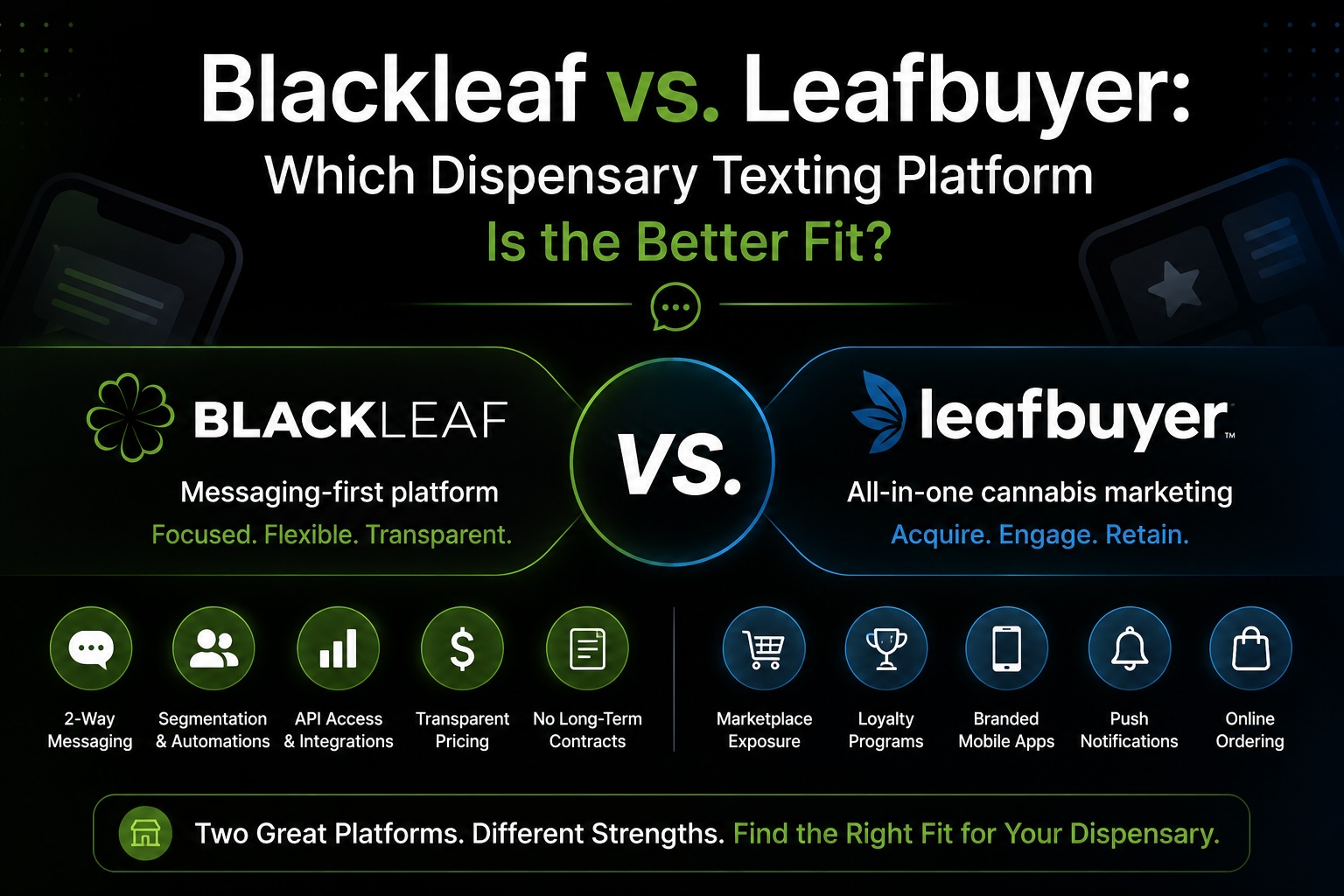
Blackleaf is centered on dispensary SMS and MMS, two-way customer conversations, automations, segmentation, APIs, and flexible pricing. Leafbuyer presents a broader cannabis marketing ecosystem that combines messaging with loyalty, branded mobile applications, online ordering, push notifications, and exposure through the Leafbuyer consumer network.
That distinction matters. A dispensary searching for the best texting platform may not need an entire marketing suite. Conversely, an operator looking to consolidate loyalty, an app, ordering, and consumer acquisition may value a broader bundle.
This guide compares Blackleaf and Leafbuyer based on product focus, messaging functionality, deliverability, inbox workflows, automation, integrations, pricing transparency, contract flexibility, loyalty, marketplace acquisition, and operational fit.
Blackleaf vs. Leafbuyer: Which One Is Better?
Blackleaf is generally the better fit when a dispensary’s primary need is a focused, flexible texting platform with published pricing, two-way messaging, API access, segmentation, automations, and POS synchronization options.
Leafbuyer may be the better fit when an operator specifically wants texting bundled with a consumer marketplace, loyalty program, branded mobile app, online ordering, and push notifications.
Neither answer applies universally. The correct choice depends on whether the dispensary wants a dedicated customer communication layer or a broader, bundled cannabis marketing ecosystem.
Blackleaf and Leafbuyer at a Glance
Blackleaf
Best suited to operators that want cannabis-focused SMS and MMS without being required to replace the rest of their retail technology stack.
Bulk SMS and MMS
Shared two-way inbox
API access
Segmentation and automations by plan
POS synchronization by plan
Published platform and message pricing
No required long-term contract on published plans
Leafbuyer
Best suited to operators that want messaging combined with loyalty, mobile apps, ordering, push notifications, and consumer marketplace exposure.
SMS and MMS campaigns
Triggered messaging
Loyalty programs
Custom branded mobile applications
Online ordering connections
Push-notification fallback
Leafbuyer.com marketplace and LeadCatcher exposure
Blackleaf vs. Leafbuyer Feature Comparison
| Category | Blackleaf | Leafbuyer |
|---|---|---|
| Core product focus | Cannabis-focused texting and customer communication | Broader cannabis marketing, loyalty, app, ordering, and marketplace platform |
| SMS and MMS | Bulk SMS and MMS included in published plans | SMS and MMS publicly offered |
| Two-way messaging | Shared inbox is publicly listed | Confirm current inbox, assignment, and reply workflow during a demo |
| Segmentation | Advanced segmentation on qualifying plans | Targeted messaging and customer-interest targeting are publicly promoted |
| Automations | Automations on qualifying plans | Triggered campaigns including birthdays, winbacks, visit summaries, and order summaries |
| API access | Full API access publicly included | Confirm current public or private API availability and scope |
| POS connectivity | POS sync publicly listed on qualifying plans | Leafbuyer publicly advertises integrations with major cannabis POS and ordering platforms |
| Loyalty | Rewards and ecommerce tools offered on the Enterprise plan | Core part of the broader Leafbuyer platform |
| Branded mobile app | Rewards app listed on the Enterprise plan | Custom-branded SmartApp is a central product offering |
| Consumer marketplace | Not the platform’s primary model | Leafbuyer.com and its network are used to promote deals and acquire subscribers |
| Public pricing | Detailed subscription, SMS, MMS, and registration pricing is published | Some entry pricing is publicly presented; full package costs should be confirmed directly |
| Contract flexibility | Published plans state no long-term contracts and cancellation at any time | Verify current commitment and cancellation terms in the proposal |
| Best fit | Operators prioritizing texting, flexibility, APIs, and transparent costs | Operators wanting marketplace exposure and a broader bundled marketing suite |
“Confirm” or “verify” means the relevant public materials did not provide enough detail to make a precise implementation-level comparison. A feature name alone does not establish how the feature behaves, what it costs, or which plan includes it.
1. Core Product Philosophy
Blackleaf: Texting as Core Infrastructure
Blackleaf is designed around the idea that texting should work as an independent communication layer. A dispensary can use Blackleaf for campaigns, customer replies, automations, order alerts, segmentation, and API-triggered messages without adopting a completely new ecommerce or retail stack.
This approach may appeal to operators that already use Dutchie, Treez, Blaze, Shopify, WooCommerce, or another established system and want messaging to connect to the tools they already have.
Leafbuyer: Texting as Part of a Broader Ecosystem
Leafbuyer positions texting as one component of a wider acquisition and retention platform. Its public offering combines SMS and MMS with loyalty, custom mobile applications, online ordering, push notifications, and consumer acquisition through the Leafbuyer network.
This can be attractive for dispensaries that want to consolidate several marketing products with one provider. It can be less relevant to operators that already have those systems and primarily need texting.
Blackleaf primarily asks: How can texting integrate with the dispensary’s existing operation?
Leafbuyer primarily asks: How many parts of the dispensary’s marketing and loyalty ecosystem can be combined into one platform?
2. SMS and MMS Campaigns
Both platforms publicly support cannabis SMS and MMS campaigns.
Blackleaf lists bulk SMS and MMS across its published plans. Its pricing page also separates SMS and MMS usage rates, allowing operators to estimate costs based on actual campaign volume.
Leafbuyer promotes SMS, MMS, links, images, targeting, campaign scheduling, and messaging tied to loyalty and customer activity. It also markets push notifications as an additional route when SMS delivery encounters filtering.
Because both providers support core outbound messaging, the decision should not be based on a simple “SMS: yes” checkmark. Buyers should compare:
Message composer usability
Recipient previews and audience estimates
Link tracking
Message-length and segment warnings
Send scheduling
Approval workflows
Suppression and frequency controls
Delivery-event reporting
Opt-out handling
Cost per completed campaign
3. Deliverability and Cannabis Messaging
Deliverability is especially important in cannabis because registration, sending behavior, message content, list quality, and carrier filtering can all affect whether a campaign reaches customers.
Blackleaf positions itself as purpose-built for regulated messaging and publishes dedicated resources about 10DLC registration, carrier filtering, number warming, consent, and rejected messages.
Leafbuyer promotes proprietary delivery technology, multiple delivery pathways, and push-notification fallback through its mobile app product.
These approaches are not directly interchangeable. Push fallback may expand reach among customers who have installed and enabled a branded app. SMS deliverability controls affect messages sent to the underlying mobile number.
Ask Both Providers to Define “Delivered”
Before relying on a delivery-rate claim, ask what the reported metric represents:
Accepted by the platform
Submitted to an upstream messaging provider
Accepted by the carrier
Reported as delivered to the handset
Delivered by SMS or by a fallback channel
Calculated before or after excluding invalid and suppressed numbers
Without a shared definition, delivery percentages from two providers cannot be meaningfully compared.
For more detail, review dispensary SMS deliverability and carrier filtering.
4. Two-Way Messaging and Customer Replies
Text campaigns generate replies. Customers ask whether a promotion applies, whether an order is ready, what time the store closes, or whether a product remains available.
Blackleaf publicly includes an inbox in its Basic plan and describes it as a shared system for managing two-way customer conversations.
Leafbuyer’s public materials emphasize outbound campaigns, triggered messaging, loyalty, applications, and delivery pathways. Operators evaluating Leafbuyer should request a live demonstration of its current reply-management workflow rather than assuming that all texting inboxes operate the same way.
Questions to Test
Can multiple employees use the inbox?
Can conversations be assigned?
Can users add notes or tags?
Do employees receive alerts for unanswered replies?
Can managers see response time?
Is the customer’s campaign and purchase context visible?
Can replies be routed by store or department?
See how Blackleaf approaches this through its two-way messaging inbox.
5. Automations and Customer Journeys
Both platforms publicly offer automation capabilities.
Blackleaf lists automations on its Business plan and supports repeatable messaging for retention, reminders, follow-ups, and API-triggered campaigns.
Leafbuyer publicly describes Auto-Connect campaigns for events such as birthdays, customer winbacks, visit summaries, order summaries, and loyalty-related activity.
The correct question is therefore not whether either platform “has automations.” The buyer should determine how much control each automation provides.
Automation Evaluation Checklist
Which events can start a workflow?
Can POS purchases trigger messages?
Can a purchase stop an active winback sequence?
Can workflows branch based on customer behavior?
Can the automation exclude recently messaged customers?
Can each store run different automations?
Can replies be routed to an inbox?
Can results be attributed to purchases?
Can automations be managed through an API?
Explore Blackleaf automations and the guide to dispensary SMS automation flows.
6. POS Integration, APIs, and Data Connectivity
Both companies publicly discuss integrations, but the term “integration” can describe very different technical capabilities.
Blackleaf publishes POS sync on its Business plan and full API access on its pricing page. Its product positioning favors connecting messaging with an operator’s existing systems.
Leafbuyer publicly advertises integrations with major cannabis POS and ordering providers, including Dutchie, Jane, and Treez, and says it can work with additional providers to establish connections.
Do Not Settle for “Yes, We Integrate”
Ask each vendor to show:
Which systems are connected today
Whether the connection is native, partner-managed, or custom
Which customer fields synchronize
Whether transaction and product data are included
How frequently data updates
Whether events can trigger automations
Whether campaign conversions write back to the POS
What the integration costs
What happens when the connection fails
7. Loyalty, Mobile Apps, and Online Ordering
This is where Leafbuyer’s broader product strategy becomes most distinct.
Leafbuyer publicly promotes:
Points-per-visit and points-per-spend loyalty
A digital rewards wallet
Custom-branded mobile applications
Push notifications
Purchase history
Online ordering connections
Deals connected to Leafbuyer.com
Blackleaf’s Enterprise plan publicly lists rewards, an ecommerce website, a rewards application, and unlimited push notifications. However, Blackleaf’s primary market identity remains messaging-first rather than app-first or marketplace-first.
Leafbuyer may have the advantage when a dispensary explicitly wants those capabilities purchased as a combined ecosystem. Blackleaf may have the advantage when the operator already has ecommerce and loyalty systems and does not want to replace them merely to improve texting.
8. Marketplace and Subscriber Acquisition
Leafbuyer has a differentiator that Blackleaf does not attempt to replicate directly: its consumer-facing marketplace and advertising network.
Leafbuyer says campaigns can be converted into web-based ads and promoted through Leafbuyer.com and related network placements. Its LeadCatcher positioning is intended to help participating dispensaries attract new subscribers in addition to messaging existing ones.
That capability may be valuable to operators that want marketplace-based exposure and are in regions where Leafbuyer has a meaningful consumer audience.
Before assigning value to marketplace acquisition, request store-specific evidence:
How many relevant consumers are active in the store’s market?
How many subscribers were acquired for comparable locations?
What consent disclosure accompanies each subscriber?
Does the dispensary own and export the acquired contact?
How many acquired subscribers complete a purchase?
What is the cost per acquired and purchasing customer?
Blackleaf is more focused on helping operators communicate with and monetize their own first-party audience through campaigns, automations, integrations, and APIs.
9. Pricing Transparency and Total Cost
Blackleaf publishes detailed pricing for its primary plans.
| Blackleaf Plan | Platform Price | SMS Rate | MMS Rate | Selected Features |
|---|---|---|---|---|
| Basic | $29 per month | $0.05 | $0.07 | Unlimited contacts, campaigns, inbox, landing page, API access |
| Business | $99 per month | $0.03 | $0.05 | Segmentation, automations, priority support, POS sync |
| Enterprise | $199 per month, billed quarterly | $0.02 | $0.04 | Rewards, ecommerce website, app, push notifications |
Blackleaf also discloses registration charges, included carrier fees, and a compliance fee on message usage. Always review the current Blackleaf pricing page for updates.
Leafbuyer publicly presents entry-level pricing in some of its comparison materials, but the total cost of a customized suite may depend on messaging volume, loyalty, applications, ordering, integrations, locations, support, and other selected products.
Request the Same Cost Breakdown From Both Providers
Monthly platform subscription
SMS and MMS usage
Carrier fees
Compliance or registration fees
Phone-number fees
Contact limits
Location fees
User fees
POS integration
API access
Loyalty
Mobile application
Online ordering
Implementation and onboarding
Support
Early termination
The cheapest advertised monthly plan is not necessarily the lowest total cost. Calculate each proposal using the dispensary’s actual message volume, average message length, location count, and required products.
10. Contract Flexibility
Blackleaf’s current published pricing states that its plans do not require a long-term contract and can be canceled at any time.
Leafbuyer’s current contract structure should be confirmed directly in the specific proposal. The buyer should not assume that terms are identical across all Leafbuyer products or account sizes.
Review These Terms Before Signing
Initial commitment length
Automatic renewal
Required cancellation notice
Early termination charges
Minimum monthly usage
Price increases during the term
Data export after cancellation
Phone-number portability
Ownership of creative assets and landing pages
Read what to know about annual contracts for dispensary marketing technology.
Which Platform Wins Each Category?
These category judgments reflect product positioning and publicly documented capabilities, not a laboratory performance test. Operators should validate implementation details using their own POS, customer data, campaign workflow, and expected volume.
When Blackleaf Is the Better Fit
Blackleaf is likely the better option when the dispensary:
Primarily needs SMS and MMS rather than a complete software replacement
Wants pricing available before entering a sales process
Does not want a required long-term commitment
Needs a shared two-way customer inbox
Needs API access for custom workflows
Wants automations and segmentation without purchasing a marketplace package
Already has ecommerce and loyalty tools
Wants its messaging platform to fit into the existing stack
Values direct control over costs and message usage
When Leafbuyer May Be the Better Fit
Leafbuyer may be the better option when the dispensary:
Specifically wants access to the Leafbuyer consumer marketplace
Wants messaging and loyalty purchased from one provider
Wants a custom-branded mobile application
Values push notifications as an additional communication channel
Wants online ordering tied into the same broader ecosystem
Wants marketplace-generated subscriber acquisition
Prefers consolidating several marketing functions under one vendor
How to Test Blackleaf and Leafbuyer Fairly
Do not make the decision using only a sales presentation. Give both platforms the same operational test.
Import the same sample audience. Include location, consent, purchase, and engagement data.
Build the same three segments. Use active customers, lapsed customers, and category buyers.
Create the same SMS and MMS campaign. Compare workflow, previews, targeting, and cost.
Build the same winback automation. Compare available triggers, exclusions, and reporting.
Test customer replies. Evaluate inbox alerts, assignment, context, and response workflow.
Review delivery reporting. Confirm what each status means.
Test the integration. Verify actual fields and synchronization behavior.
Export the data. Confirm ownership and portability before signing.
Calculate a 12-month cost. Include every platform, message, location, registration, integration, and support charge.
Open a support request. Evaluate the quality and speed of the real response.
Blackleaf vs. Leafbuyer
Blackleaf has the clearer advantage for dispensaries that primarily want a modern cannabis texting platform. Its public offering emphasizes SMS, MMS, a two-way inbox, API access, segmentation, automations, POS synchronization, published usage rates, and flexible subscription terms.
Leafbuyer has the clearer advantage when marketplace acquisition and bundled marketing products are central to the buying decision. Its consumer network, loyalty platform, SmartApp, push notifications, and ordering connections create a broader ecosystem than a messaging-only comparison would capture.
The decision is therefore less about which company has the longest feature list and more about which operating model the dispensary wants:
Choose Blackleaf when texting is the primary requirement and the platform should fit into the existing stack.
Consider Leafbuyer when the goal is to combine messaging with marketplace exposure, loyalty, applications, and ordering.
Frequently Asked Questions
Is Blackleaf better than Leafbuyer?
Blackleaf is generally the better fit for dispensaries that prioritize focused SMS and MMS, transparent pricing, two-way messaging, APIs, flexible terms, segmentation, and automation. Leafbuyer may be the better fit for operators that specifically want marketplace acquisition, loyalty, a branded application, push notifications, and ordering within a broader suite.
Do Blackleaf and Leafbuyer both support dispensary SMS and MMS?
Yes. Both providers publicly offer SMS and MMS for cannabis dispensaries. Buyers should compare the campaign workflow, reporting, segmentation, cost structure, delivery definitions, and reply-management experience rather than relying on a simple feature checkmark.
Which platform has more transparent pricing?
Blackleaf publishes its primary subscription prices, SMS and MMS rates, registration charges, carrier-fee treatment, compliance fee, and contract approach. Leafbuyer publicly presents some pricing information, but operators should request a complete written proposal covering every selected product and charge.
Does Blackleaf require an annual contract?
Blackleaf’s current published pricing states that no long-term contract is required and customers can cancel at any time. Confirm the current terms presented during signup.
Does Leafbuyer have a consumer marketplace?
Yes. Leafbuyer operates a consumer-facing cannabis deals and discovery network and publicly promotes LeadCatcher and its Total Network Solution as methods for attracting subscribers and customers.
Do both platforms offer automations?
Yes. Blackleaf publicly lists automations on qualifying plans. Leafbuyer publicly markets triggered campaigns such as birthdays, winbacks, visit summaries, and order summaries.
Do Blackleaf and Leafbuyer integrate with dispensary POS systems?
Both companies publicly discuss POS connectivity. The exact supported systems, fields, synchronization frequency, automation triggers, setup requirements, and costs should be confirmed for the dispensary’s specific POS.
Which platform is better for a single-location dispensary?
Blackleaf may be a stronger fit for a single-location operator that mainly needs affordable texting, a customer inbox, API access, automation, and flexible terms. Leafbuyer may make more sense when the store also wants a bundled loyalty program, mobile application, ordering, and marketplace exposure.
Which platform is better for a multi-location operator?
The answer depends on the broader technology strategy. Blackleaf may suit operators that want location-aware texting connected to an existing stack. Leafbuyer may suit operators seeking a consolidated marketing, loyalty, application, and marketplace ecosystem. Multi-location buyers should test permissions, reporting, reply routing, suppression, location fees, and data ownership.
Can a dispensary switch from Leafbuyer to Blackleaf?
A switch may be possible if the dispensary can export its contacts and applicable consent records. Before migration, confirm data ownership, number portability, suppression lists, customer tags, active automations, loyalty dependencies, and any existing contract obligations.
Methodology and Limitations
This comparison was prepared using publicly available product, pricing, feature, and marketing information published by Blackleaf and Leafbuyer and reviewed in July 2026.
We did not treat the absence of public documentation as proof that a capability does not exist. Where implementation details could not be established from public information, the article instructs buyers to verify them directly.
No independent delivery test, controlled conversion study, or complete contract audit was conducted for this article. Product performance can vary based on registration, list quality, consent, message content, market, carrier, integration, send volume, employee execution, and campaign strategy.
Blackleaf publishes this page and benefits commercially when readers choose Blackleaf. Readers should consider that interest, review primary sources, request written proposals, and conduct an operational trial before making a final decision.