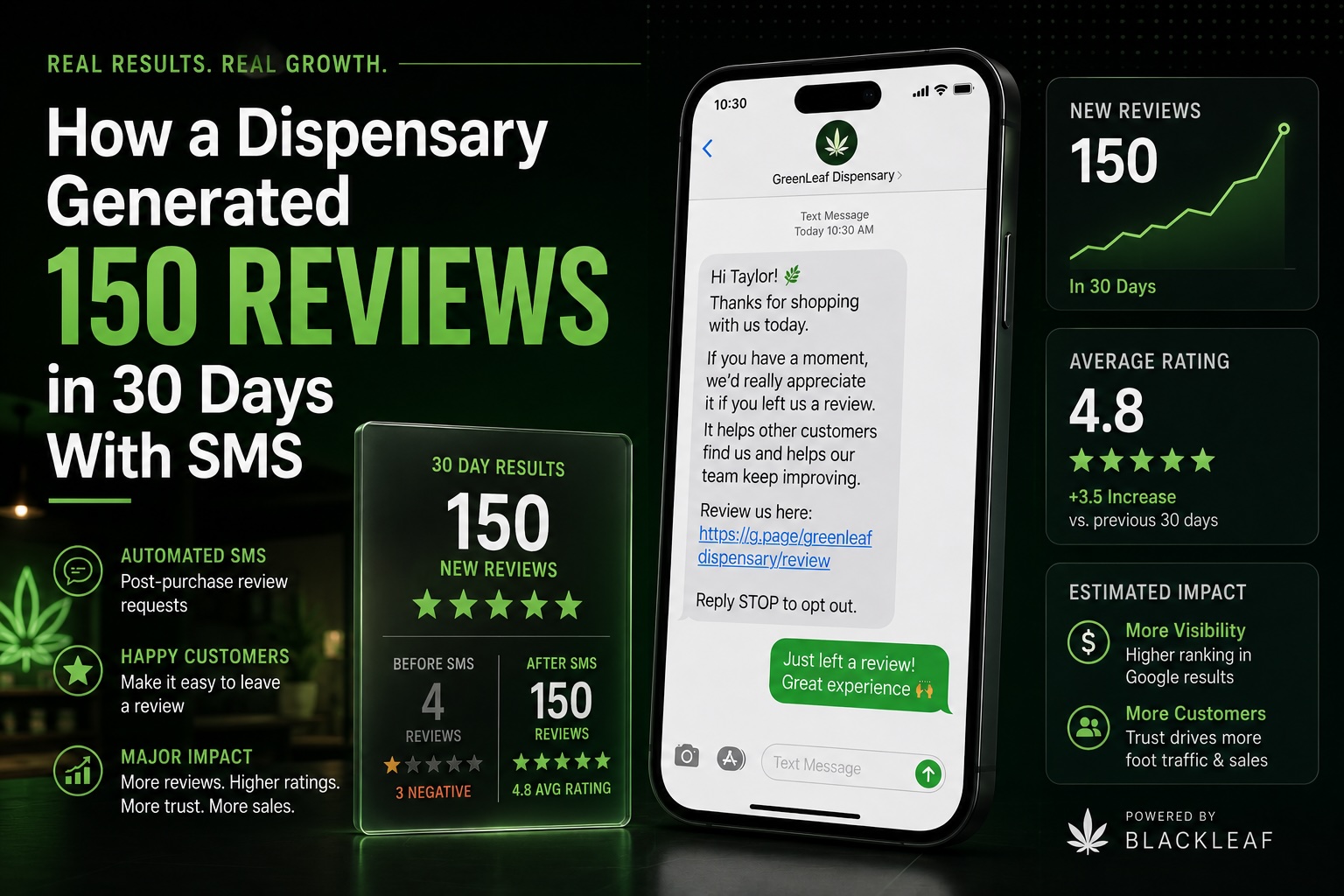
A dispensary using Blackleaf generated 150 customer reviews during a 30-day post-purchase SMS campaign. During the previous 30 days, the dispensary received four reviews, three of which were negative. The campaign increased review volume by making the request timely, mobile-friendly, measurable, and part of the normal customer communication workflow.
Total customer reviews recorded before the SMS review campaign.
Three of the four reviews in the prior period were negative.
Customer reviews generated during the 30-day SMS campaign.
Most dispensaries have substantially more completed transactions than customer reviews. The problem is rarely that no customers are willing to leave feedback. The problem is that the request is inconsistent, poorly timed, difficult to complete, or never made at all.
This case study examines how a dispensary moved review requests into an automated post-purchase SMS flow and generated 150 reviews in 30 days, compared with four reviews during the previous 30-day period.
The result does not establish a guaranteed review rate for every store. Customer volume, existing reputation, message timing, consent, store experience, age-gate completion, and review-platform behavior all affect performance. The value of the case study is the operating framework: identify eligible customers, make the request at a relevant moment, reduce friction, route feedback appropriately, and measure the complete flow.
The dispensary review campaign results
The comparison covered two consecutive 30-day periods:
| Measurement period | Total reviews | Observed context |
|---|---|---|
| 30 days before campaign | 4 reviews | Three of the four reviews during this period were negative. |
| 30-day SMS campaign | 150 reviews | Post-purchase review requests were incorporated into the customer messaging workflow. |
The raw increase was 146 additional reviews between the two measured periods.
The campaign-period review count was 37.5 times the prior-period count. This comparison describes the observed change in review volume. It should not be interpreted as proof that every additional review resulted from one isolated variable, because other store and customer conditions can change between periods.
The results in this article describe one dispensary’s observed 30-day campaign performance. They are not a promise, projection, or guaranteed result for other Blackleaf customers.
The problem before the SMS campaign
The dispensary was serving customers every day, but only a small number were leaving public reviews.
During the 30 days before the campaign, the business received four reviews. Three were negative. That created an imbalanced public picture of the customer experience.
Negative experiences often motivate customers to take immediate action. Satisfied customers may intend to leave a review but move on with their day unless the business makes the process timely and convenient.
Why passive review collection underperforms
The request is inconsistent
Employees may remember to ask some customers and forget during busy periods.
The timing is weak
A receipt, counter sign, or later email may reach the customer after the store experience is no longer top of mind.
The process has friction
Customers may need to search for the dispensary, find the correct location, and locate the review interface themselves.
Only unhappy customers feel urgency
A negative experience creates a strong reason to post immediately, while a routine positive visit may not.
The campaign did not attempt to manufacture customer sentiment. It made the feedback opportunity more visible to customers who had recently completed a transaction.
The dispensary SMS review strategy
Send an eligible recent customer a concise post-purchase text message, lead the customer through an age-appropriate mobile flow, collect feedback, and make the next step easy to complete.
The campaign was built around four operational principles:
- Ask after a real customer interaction. The review request was associated with a recent dispensary visit rather than sent as an unrelated mass campaign.
- Use a direct mobile channel. The customer received the request through SMS on the same device used to complete the review.
- Reduce the number of steps. The customer did not need to search manually for the correct store listing.
- Measure the complete flow. The dispensary could compare review volume before and after the campaign.
The post-purchase review-request flow
An eligible customer completes a purchase
The transaction creates the customer event used to determine eligibility for the review-request workflow.
The customer enters the review automation
Consent, suppression status, customer information, prior messaging, and other eligibility rules are evaluated before a message is sent.
The review-request text is delivered
The message identifies the dispensary, asks for feedback, and provides one clear mobile link.
The customer completes the age gate
The linked experience applies the age-control step used by the dispensary’s regulated messaging workflow.
The customer provides feedback
The flow gives the customer a simple opportunity to describe the store experience or continue toward the appropriate destination.
The customer reaches the review destination
The mobile journey reduces the need to search manually for the correct dispensary location or listing.
The dispensary monitors results
Review activity, customer feedback, flow completion, and campaign-period results are reviewed operationally.
What the dispensary review-request text should say
The message should be short enough to understand immediately and specific enough that the customer knows who is asking and why.
A practical structure includes:
- The dispensary name
- A reference to the recent visit
- A direct request for customer feedback
- One approved mobile link
- Required sender and opt-out information
The exact wording should reflect the dispensary’s consent process, messaging rules, branding, jurisdiction, and review-platform policies. The illustrative message above is not a universal compliance template.
Avoid overloading the message
The review request should not compete with several promotions, loyalty updates, product announcements, and unrelated calls to action.
The customer should understand that the message is about feedback and should see one obvious next step.
Do not make the request misleading
The message should not imply that a positive review is required, that a customer must post publicly to receive ordinary service, or that only one type of opinion is welcome.
Why the age gate mattered
A dispensary operates in an age-restricted category. The linked review experience therefore cannot be treated exactly like a generic restaurant or apparel-store campaign.
An age gate can help separate the initial text-message interaction from the regulated destination and apply the business’s audience-eligibility controls.
The age gate should be:
- Mobile-friendly
- Fast enough that customers do not abandon unnecessarily
- Consistent with the dispensary’s legal and compliance process
- Connected with the correct store and customer journey
- Measured so operators understand completion and abandonment
Learn more about Blackleaf’s age-gating tools for regulated messaging.
When should a dispensary send a review-request text?
The review request should arrive while the customer can still remember the visit, but not at a moment that feels disruptive or premature.
The ideal timing depends on:
- Whether the order was completed in-store, for pickup, or for delivery
- How quickly transaction data reaches the messaging platform
- The dispensary’s normal hours
- Whether the customer received other automated messages
- Whether an order issue remains unresolved
- The customer’s local time
Avoid immediate automation overlap
A customer may already receive an order confirmation, order-ready alert, digital receipt, loyalty update, or promotional text near the transaction. The review request should be coordinated with these messages.
Sending several texts within a short period can make even a reasonable review request feel excessive.
The best trigger is not simply “transaction exists.” The automation should also consider whether the customer is eligible, whether the purchase was completed successfully, whether another message was recently sent, and whether the request arrives during an appropriate communication window.
How the review campaign was measured
The clearest outcome was the change in completed review volume across two equal 30-day periods.
The basic comparison was:
- Four reviews in the 30 days before the campaign
- 150 reviews during the 30-day campaign period
For future campaigns, a stronger measurement framework should also track:
Eligible transactions
The number of completed customer transactions that qualified for the review flow.
Messages attempted
The number of eligible customers to whom the platform attempted to send the review request.
Messages delivered
The number of review-request messages that reached a delivered state.
Link engagement
Unique customers who opened the age-gated feedback experience.
Age-gate completion
The number of customers who successfully completed the eligibility step.
Completed reviews
Public reviews recorded during the campaign measurement period.
Useful review-campaign formulas
| Metric | Calculation | What it helps diagnose |
|---|---|---|
| Delivery rate | Delivered messages ÷ attempted messages | List quality and message delivery |
| Link engagement rate | Unique visitors ÷ delivered messages | Message relevance and call-to-action clarity |
| Flow completion rate | Completed flows ÷ unique visitors | Age-gate and landing-page friction |
| Review rate | Completed reviews ÷ delivered messages | Overall campaign effectiveness |
| Review rate per transaction | Completed reviews ÷ eligible transactions | Store-level review-generation efficiency |
Do not assume every public review came from the campaign
Some customers may leave a review independently. Others may see a store sign, receive a staff request, or arrive through another channel.
The before-and-after comparison demonstrates a strong observed association between the SMS campaign period and increased review volume. A platform-level click-to-review measurement can provide more direct evidence when the destination and review platform expose enough data.
Why the review-request SMS campaign worked
The request followed a real customer visit
The message was connected with a recent transaction, giving the customer clear context for the request.
SMS matched the task
The customer received the request on a mobile device and could continue through the review flow without moving to another device.
The campaign reduced search friction
The customer did not need to search for the dispensary, determine which location was correct, and locate the review interface manually.
The process operated consistently
The request did not depend on an employee remembering to ask while serving customers during a busy shift.
The campaign reached more than the most upset customers
Customers with a negative experience often take initiative on their own. The automated request gave customers with ordinary or positive experiences a visible path to provide feedback as well.
The result was measurable
The dispensary could compare the 30-day campaign period with an equal period immediately before the campaign.
Review gating, compliance, and platform policies
Review-request programs require more than an effective text message. Dispensaries should consider applicable messaging rules, consent, age restrictions, consumer-protection requirements, and the policies of the review platform being used.
Do not suppress legitimate negative feedback
A customer-feedback flow can help a business identify and resolve service problems, but it should not be designed to mislead customers or prevent people with negative experiences from expressing honest opinions.
Review platforms may prohibit practices commonly described as review gating, including selectively soliciting public reviews only from customers expected to be positive.
The dispensary should review the current policies of each public review platform and have qualified counsel assess its specific workflow.
Do not offer undisclosed incentives for positive reviews
A reward tied specifically to a positive public review can create legal, ethical, and platform-policy problems.
A dispensary considering any incentive-based feedback program should obtain legal guidance and ensure that required disclosures and platform-specific rules are followed.
Respect SMS consent and opt-outs
A review request sent by text is still part of the dispensary’s messaging program. The business should evaluate consent, sender identification, STOP handling, suppression, message timing, and recordkeeping.
Review Blackleaf’s guide to dispensary SMS opt-in and consent .
This case study explains an operational messaging workflow and does not provide legal advice. Review-platform policies and marketing laws can change. Dispensaries should review their exact workflow with qualified counsel and confirm that it complies with the current rules of the review destination.
Lessons other dispensaries can apply
Make review generation an operating process
Review collection should not depend entirely on signs, printed receipts, or an employee remembering to ask.
Define the event that starts the request, the eligibility rules, message timing, customer destination, suppression logic, and reporting method.
Measure each step, not only completed reviews
A low review count can result from failed delivery, weak message copy, age-gate abandonment, an incorrect destination, review-platform friction, or a poor store experience.
Tracking the full journey helps the operator identify where the process is breaking.
Use location-specific review destinations
A multi-location dispensary should send each customer to the correct store listing. Sending customers to the wrong location weakens attribution and can create inaccurate local reputation data.
Coordinate with customer service
Private feedback should reach a monitored team or workflow. Collecting customer concerns without reviewing or resolving them creates another operational failure.
Protect the customer experience
The review request should not arrive while an order problem remains unresolved or immediately after several other automated texts.
Do not overuse the automation
Repeat customers should not receive a review request after every visit without limits. Frequency controls can prevent the workflow from becoming repetitive.
Dispensary review-request SMS checklist
Before launching the campaign
- Define which completed transactions are eligible.
- Confirm the SMS consent basis for each recipient.
- Exclude suppressed and invalid customer numbers.
- Set a reasonable delay after the transaction.
- Coordinate the request with order and loyalty messages.
- Use the correct review destination for each location.
- Test the complete mobile experience.
- Confirm the age gate works on common devices.
- Review current public-review platform policies.
- Document STOP and HELP handling.
- Define frequency limits for repeat customers.
- Assign responsibility for private customer feedback.
- Record the pre-campaign review baseline.
- Define the campaign measurement period.
- Have qualified counsel review the workflow.
After launching the campaign
Monitor these signals
- Eligible customer count
- Messages attempted
- Messages delivered
- Delivery failures
- Unique link visitors
- Age-gate completion
- Feedback-flow completion
- Completed public reviews
- Private customer concerns
- Response time to customer issues
- Campaign opt-outs
- Reviews by store location
- Review volume compared with baseline
- Review sentiment and recurring themes
How Blackleaf supports dispensary review campaigns
Blackleaf helps dispensaries create post-purchase customer messaging, automated review requests, age-gated mobile experiences, customer segmentation, two-way communication, suppression controls, and campaign reporting.
The same operating framework can be adapted for individual stores and multi-location dispensary groups while directing customers to the correct location-specific experience.
Explore Blackleaf’s dispensary SMS automations, age-gating tools, and dispensary text messaging platform.
Frequently asked questions
How many reviews did the dispensary generate with SMS?
The dispensary generated 150 customer reviews during the 30-day SMS campaign period. It received four reviews during the previous 30 days.
How many reviews did the dispensary have before the campaign?
The dispensary received four reviews during the 30 days before the SMS campaign. Three of those four reviews were negative.
What is a dispensary review-request text?
A dispensary review-request text is a message sent to an eligible customer after a store interaction asking the customer to provide feedback or visit an approved review destination.
When should a dispensary send a review-request SMS?
The message should generally follow a completed customer interaction while the visit is still recent. The exact timing should account for transaction completion, customer consent, local time, unresolved service issues, and other automated messages.
Should a dispensary ask every customer for a review?
Eligibility should be based on consent, transaction status, customer identity, suppression rules, frequency limits, location, and other operational requirements. Repeat customers should not necessarily receive a request after every visit.
Why use SMS instead of email for dispensary review requests?
SMS places the request directly on the customer’s mobile device and can reduce the number of steps between the request and the review destination. The better channel depends on customer consent, campaign design, deliverability, and customer preference.
What should a dispensary review-request text say?
The message should identify the dispensary, reference the recent customer interaction, ask clearly for feedback, provide one approved mobile link, and include required sender and opt-out information.
Can a dispensary offer a reward for a positive review?
Rewarding only positive public reviews can create legal, ethical, and platform-policy concerns. Dispensaries should review the current rules of the review platform and obtain legal advice before offering any incentive connected with customer reviews.
What is review gating?
Review gating generally refers to selectively directing customers toward a public review opportunity based on whether their feedback is expected to be positive. Review platforms may prohibit this practice.
Are 150 reviews in 30 days guaranteed with Blackleaf?
No. The result describes one dispensary’s observed campaign performance. Review volume depends on transaction volume, customer participation, consent, delivery, store experience, message timing, flow completion, and other factors.
How should dispensaries measure a review-request campaign?
Track eligible transactions, attempted and delivered messages, unique link visits, age-gate completion, feedback-flow completion, public reviews, private feedback, opt-outs, and comparison with a defined pre-campaign baseline.
Make customer review requests part of the dispensary workflow
Blackleaf helps dispensaries automate post-purchase review requests, apply age-gated customer journeys, manage messaging eligibility, and measure results without relying on staff to remember every request.
Talk to BlackleafCase-study methodology note: The reported result compares the dispensary’s observed review count during a 30-day SMS campaign with the immediately preceding 30-day period. The campaign period produced 150 reviews. The prior period produced four reviews, three of which were negative. The comparison was not presented as a randomized controlled test, and outside variables may have influenced results.
This article is provided for general educational and operational purposes and does not constitute legal advice. Messaging consent, consumer-review rules, advertising requirements, age restrictions, and review-platform policies vary. Dispensaries should obtain qualified legal advice and review the current policies of each review platform before launching a review-request campaign.