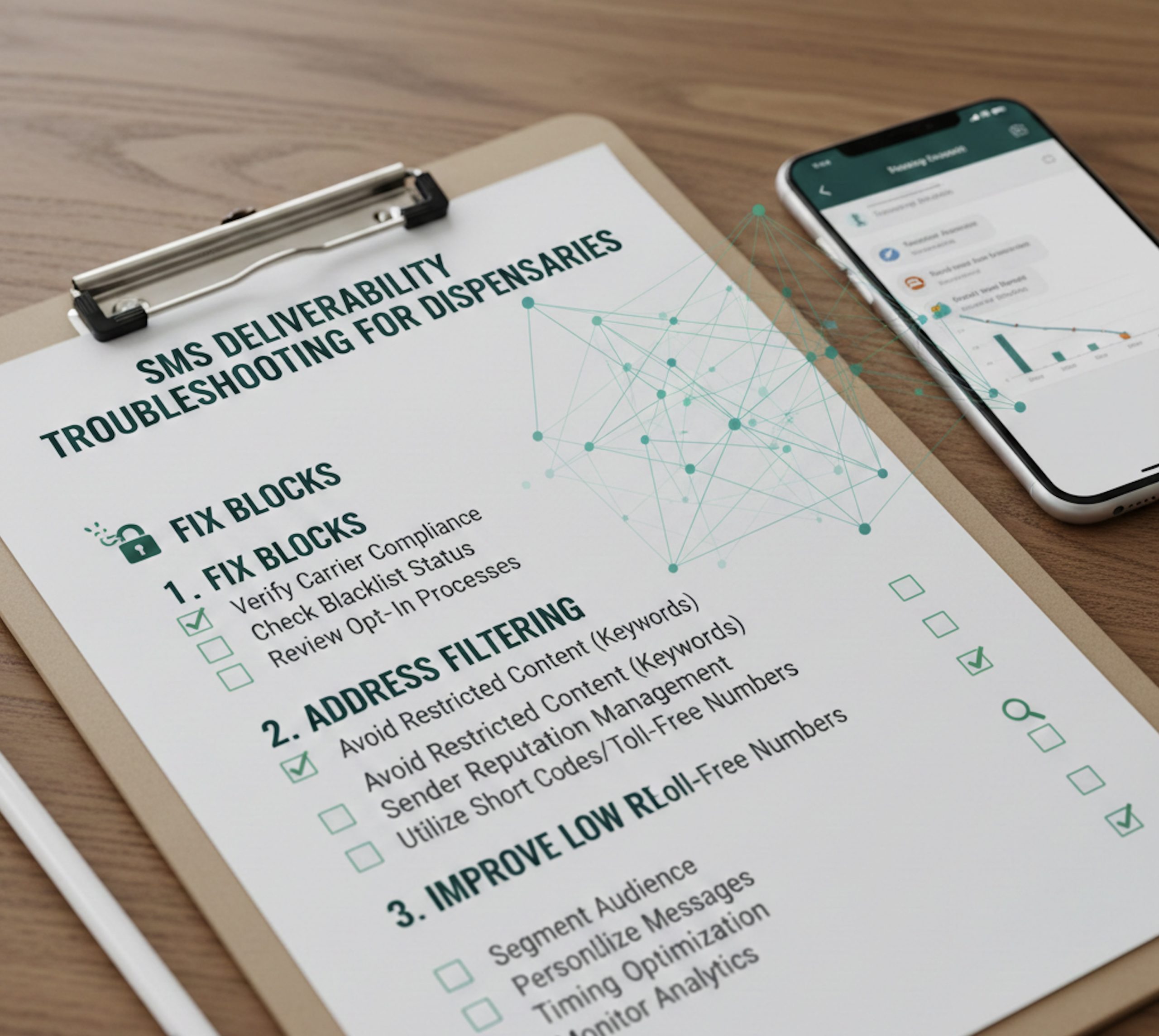
Definition (what it is, who it is for, when to use it)
SMS deliverability troubleshooting is the process of identifying why your text messages are not reaching customers (or are reaching fewer customers than expected), then fixing the underlying causes so your sending program becomes stable and predictable.
This guide is for dispensary operators, marketers, and compliance owners who send customer texts for order updates, loyalty, and store communications, especially when you notice sudden drops in delivery, higher failure rates, or unusual opt-out spikes.
Use this when you see any of the following: delivery rates fall week-over-week, campaigns that used to perform now underperform, carriers start filtering content, customers report not receiving messages, or your sending number feels “burned” after a high-volume push. If you are new to the topic, start with the fundamentals in SMS deliverability and carrier filtering, then return here for diagnosis.
Why This Matters for Dispensaries
Dispensaries are a regulated, high-scrutiny category. That means your SMS program can fail in ways that look like “tech issues” but are often caused by compliance signals, inconsistent consent records, content patterns carriers treat as risky, or volume behavior that resembles spam.
When deliverability drops, you lose more than sales. You lose operational reliability. Order pickup texts do not arrive on time. Two-way chat becomes unreliable. Customers believe you ignored them. Your staff wastes time answering “Did you text me?” instead of serving customers.
Deliverability also affects performance marketing math. If only part of your list receives a message, your campaign reporting gets distorted. You might incorrectly blame creative, timing, or offer strategy when the real issue is reach. If you run high-frequency sending, review mass texting practices and align your program with consent and opt-out expectations from SMS opt-in and opt-in and consent for dispensaries.
Step-by-Step Implementation
Use this workflow every time deliverability declines. The goal is to isolate whether the issue is list quality, consent, content filtering, sending behavior, or registration and identity signals.
-
Confirm the symptom with numbers, not anecdotes. Compare sends vs deliveries vs failures over the same time window. Separate transactional messaging (order updates) from marketing blasts. If you use automation, confirm whether the issue is isolated to a workflow in automations.
-
Segment by carrier and message type. A problem that hits one carrier more than others usually points to filtering, trust, or content. A problem that hits all carriers at once often points to identity, consent, list quality, or sending behavior.
-
Check consent and opt-out mechanics first. Confirm you can prove opt-in for the segment you texted, and confirm STOP is honored quickly. If your opt-in flow is unclear, fix it using opt-in and consent for dispensaries and SMS opt-in.
-
Review content for filtering triggers. Look for repeated patterns, aggressive language, suspicious URL patterns, excessive capitalization, and phrases that can be interpreted as restricted promotion. For cannabis, you must also account for category scrutiny. Use a content discipline that reduces filtering risk, and keep a safe reference library like SMS message templates.
-
Inspect sending behavior and volume ramps. Carriers watch sending spikes. If you doubled volume overnight, shortened intervals, or reused the same template to the full list, you may have created filtering signals. Consider pacing strategies and controls that reduce carrier suspicion, including approaches like Smart Routing when available.
-
Validate your sender identity and registration posture. If you send A2P traffic, ensure your brand and campaign registration are correct and aligned with your actual use case. If you are unsure how this affects dispensaries, review 10DLC for dispensaries and your overall compliance posture.
-
Run a controlled test. Send a small, compliant, low-risk message to a known seed list across major carriers. Keep the message short, informational, and consistent with the consent context. If the test succeeds but campaigns fail, the problem is likely content, volume, or segmentation.
-
Document fixes and lock a standard operating procedure. Deliverability is not a one-time project. Build a repeatable checklist. This is how you prevent regressions when staff, creative, or cadence changes.
Common Mistakes
-
Assuming “delivered” means “seen.” Carriers may allow delivery while still applying inbox placement pressure, throttling, or downstream filtering. Watch conversion and reply rates alongside delivery.
-
Texting old lists without re-permissioning. A stale list increases complaints, opt-outs, and filtering risk. If you collect numbers at checkout, make sure consent language is clear and tied to the customer action, then keep records aligned with consent requirements.
-
Copy-pasting the same message every day. Repetition is a filtering signal. Build variation while staying compliant and consistent. A templates library like SMS message templates helps maintain structure without repeating exact phrasing.
-
Overusing links or using suspicious link patterns. Shorteners, redirect chains, and inconsistent domains increase filtering risk. Use clean, consistent links that match what customers expect from your brand.
-
Failing to separate marketing from transactional flows. Order status messages should not look like promotions. If you want operational reliability, keep order communications aligned with order alerts behavior and keep promotional content in appropriately consented campaigns.
-
Ignoring carrier feedback loops. Sudden blocks or dips usually have a cause. Treat deliverability like a system with inputs and outputs, not as a mystery.
Practical Examples (real-world dispensary scenarios)
Scenario 1: Delivery drops after a high-volume weekend push. A dispensary sends to its full list on Friday and Saturday with nearly identical copy, then sees a 25 percent drop on Sunday. Likely cause: volume and repetition signals triggered filtering. Fix: throttle volume, rotate copy, and segment by engagement. Use smarter pacing and consider tools that reduce risk like Smart Routing while you rebuild trust.
Scenario 2: Order pickup texts are delayed or missing. Customers complain they did not get “your order is ready” messages, but marketing messages still arrive. Likely cause: workflow misconfiguration, template changes, or a sending pathway issue isolated to operational automation. Fix: isolate the flow, test operational messages separately, and verify configuration under automations and order alerts.
Scenario 3: New store launches, opt-outs spike immediately. The store imported a list from a partner and started sending weekly messages. Likely cause: weak consent provenance and mismatched customer expectations. Fix: stop blasting, run a re-permissioning campaign that aligns with the consent context, and rebuild list hygiene using SMS opt-in and opt-in and consent for dispensaries.
Scenario 4: Messages deliver on some carriers but not others. One carrier shows higher failure rates or lower reach. Likely cause: carrier-specific filtering or trust scoring reacting to content patterns. Fix: simplify language, remove risky words, reduce link density, and test across carriers. Review carrier filtering basics to understand why carriers behave differently.
Troubleshooting Table
Use this table to map what you are seeing to what to check next. Treat it as a diagnostic shortcut, not as legal advice or a guarantee of outcomes.
| What you see | Likely cause | What to check | Practical fix |
|---|---|---|---|
| Delivery rate drops across all carriers | Consent, list quality, or sending behavior shift | Opt-in proof, STOP handling, recent volume ramps | Pause high-risk sends, segment engaged users, refresh consent flows |
| Some carriers drop, others stable | Carrier filtering or trust score change | Content patterns, link usage, repetition, complaint signals | Simplify copy, remove suspicious links, rotate templates, test on seed list |
| High “failed” or “undelivered” counts | Bad numbers, inactive devices, or blocks | List age, invalid numbers, repeated sends to dead contacts | Clean list, suppress invalids, focus on active subscribers |
| Opt-outs spike after a campaign | Expectation mismatch or too-frequent sends | Consent language, cadence, message tone, targeting | Reduce frequency, improve targeting, align content to consent context |
| Order texts delayed or missing | Workflow issue or misclassified traffic | Automation rules, message templates, routing paths | Separate operational messages from marketing, test order flows end-to-end |
FAQ
Question: What is a “good” SMS delivery rate for dispensaries?
Answer: It depends on list quality, consent freshness, and sending behavior. Track trends, not a single number. If your delivery rate declines steadily, treat that as a system problem and follow the checklist in this guide. Start by understanding the basics in SMS deliverability.
Question: Why do carriers block dispensary texts even when customers opted in?
Answer: Carriers evaluate more than consent. They look at content patterns, complaint signals, link reputation, repetition, and volume behavior. Cannabis is also a higher-scrutiny category. Review carrier filtering and align content to the consent context in opt-in and consent for dispensaries.
Question: Does adding images improve deliverability?
Answer: Not automatically. MMS can change how messages are processed, but it can also introduce new filtering and content risks. Start by stabilizing SMS first, then test carefully. If you need consistent messaging structure, build a safe library from SMS message templates.
Question: How do I know if the problem is my list or my message content?
Answer: Run controlled tests. Send a compliant, low-risk message to a small seed list across major carriers. If the seed list succeeds but your broader campaign fails, the issue is likely list quality or segmentation. If the seed list fails too, suspect content, routing, or identity signals.
Question: What role does 10DLC play in deliverability?
Answer: For A2P traffic, registration helps establish identity and use-case alignment. Incorrect or mismatched registration can create deliverability instability. For dispensaries, review 10DLC for dispensaries and keep your program aligned with compliance expectations.
Question: Why do my order messages work but marketing messages fail?
Answer: Marketing content often includes language, links, cadence, and segmentation patterns that trigger more filtering. Operational messaging is usually shorter, expected, and more clearly tied to a customer action. Keep order texts aligned with order alerts and treat marketing blasts as a separate system with its own rules and safeguards.
Question: How often should dispensaries text without hurting deliverability?
Answer: There is no universal number. Frequency should match consent expectations and customer value. If opt-outs rise, frequency is likely too high or the content is not aligned to why customers subscribed. Use engagement-based segmentation, and avoid daily blasting to the entire list unless you can prove customers want that cadence.
Question: What is the fastest way to recover if a number feels “burned”?
Answer: Reduce volume, stop repeating templates, tighten targeting to engaged subscribers, and rebuild trust with low-risk informational messages. Validate opt-in clarity and STOP handling. If you have advanced routing controls, consider approaches like Smart Routing to reduce carrier risk while you stabilize.
Metrics That Matter
Deliverability is easiest to improve when you track the right metrics consistently. Focus on a small set of indicators you can review weekly.
-
Delivery rate trend: Watch week-over-week changes, not a single day snapshot.
-
Failure rate by carrier: Carrier-specific dips often indicate filtering or trust issues.
-
Opt-out rate per campaign: A spike is a strong signal of expectation mismatch, frequency problems, or content issues.
-
Complaint proxies: Sudden drops in reply rates and engagement can signal that messages are not reaching inboxes consistently.
-
Message repetition index: Track how often the same template is used across large sends. Repetition increases filtering risk.
-
List freshness: Measure the percent of subscribers who have engaged in the last 30 to 90 days.
If you want a foundation for tying these metrics to operational messaging and store workflows, review POS texting and how messaging fits into your overall system.
Sources and Further Reading
CTIA Messaging Principles and Best Practices provides industry guidelines that influence how carriers evaluate messaging programs.
The Campaign Registry (TCR) explains the 10DLC brand and campaign registration framework used in the U.S. A2P ecosystem.
The Campaign Registry CSP User Guide details the data fields and processes that impact registration accuracy and messaging trust signals.
FCC guidance on unwanted robocalls and texts summarizes consent expectations and consumer protections relevant to business texting.
FCC rules on calls and texts includes practical consent framing that helps clarify when texts require prior consent.
FTC advertising and marketing guidance outlines truth-in-advertising expectations that matter when messaging includes claims or calls-to-action.
FTC .com Disclosures explains how to make clear disclosures in digital messaging and marketing contexts.