Definition (what it is, who it is for, when to use it)
The Telephone Consumer Protection Act (TCPA) is a U.S. federal law that regulates certain types of calls and text messages sent to consumers. For dispensaries, it primarily affects how you collect consent and how you send marketing text messages.
This page is for dispensary operators, marketing managers, compliance officers, and technical teams responsible for sending customer text messages. It applies whether you send order updates, loyalty messages, winback campaigns, or mass promotions.
This guide is educational information, not legal advice. Dispensaries should consult qualified counsel to interpret how TCPA and state laws apply to their specific business.
Why TCPA matters for dispensaries
Dispensaries operate in a regulated category with high complaint sensitivity. TCPA violations can expose businesses to statutory damages per message, which means mistakes at scale can become expensive quickly.
Beyond legal exposure, weak consent practices often lead to:
High opt-out rates
Carrier filtering and blocked messages
Consumer complaints
Deliverability instability
Strong consent discipline improves both legal defensibility and performance. If you are building or auditing your program, start with opt-in and consent for dispensaries and align with SMS opt-in best practices.
Marketing vs Transactional Messages Under TCPA
Understanding the difference between marketing and transactional messaging is critical. TCPA consent standards are stricter for marketing content.
| Message Type | Example | Primary Purpose | Risk Level |
|---|---|---|---|
| Transactional | Your order is ready for pickup | Operational update tied to a customer action | Lower if purely operational |
| Marketing | 20% off all flower today | Promote products or drive sales | Higher consent standard |
| Mixed | Your order is ready. Show this text for a discount | Operational plus promotional | Elevated risk |
If you mix promotional language into order flows, you may shift a message from transactional to marketing. Keep order-related texts aligned with order alerts and separate promotional campaigns into properly consented marketing sends.
Step-by-Step: Building a TCPA-aware SMS Program
-
Document how you collect consent. Capture where, when, and how a customer opted in. Checkout, online forms, and keyword opt-ins must clearly state they are signing up for text messages.
-
Align consent language with message type. If you plan to send marketing texts, the consent must reflect that expectation. Review consent standards for dispensaries.
-
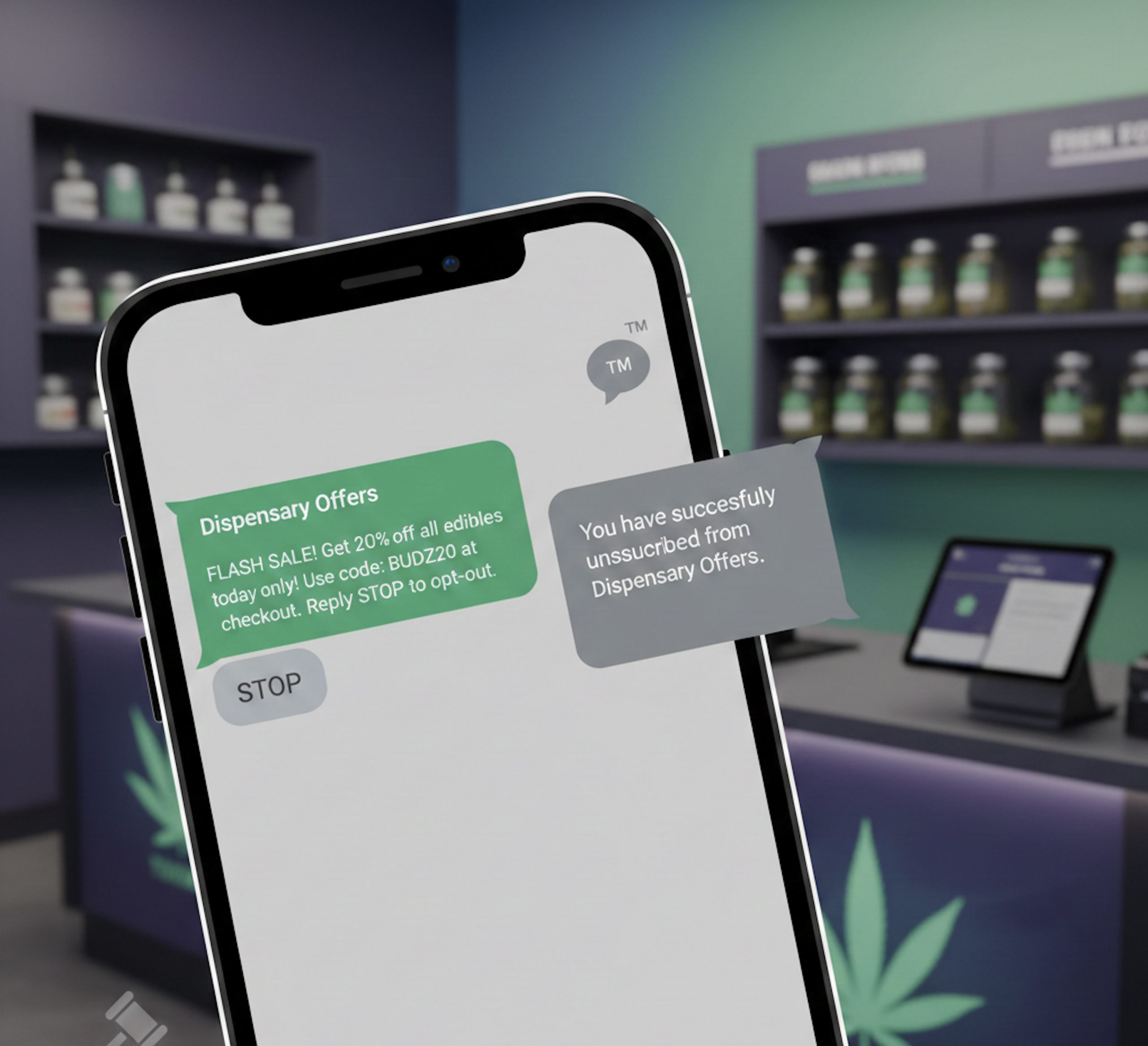
Implement functional opt-out handling. STOP should immediately suppress the number across campaigns and automations. Do not manually re-add opted-out contacts.
-
Separate operational and marketing systems. Keep transactional flows isolated from marketing campaigns to reduce classification risk.
-
Monitor frequency and behavior. Excessive messaging increases complaints and carrier scrutiny. Review mass texting strategy and avoid over-sending.
-
Confirm A2P registration posture. If you use application-to-person messaging routes, align with 10DLC for dispensaries requirements.
-
Track deliverability trends. If complaints increase, deliverability may decline. Use SMS deliverability and carrier filtering diagnostics.
Common TCPA Mistakes in Dispensary Texting
Assuming a phone number equals consent. Collecting a number for receipts does not automatically grant permission for marketing messages.
Weak or vague opt-in disclosures. Consent language must match what you send.
Ignoring opt-out signals. STOP must function consistently across systems.
Over-sending after opt-in. Frequency should align with customer expectations.
Importing purchased or third-party lists. If you cannot prove how consent was obtained, you increase legal and deliverability risk.
Practical Examples (real-world dispensary scenarios)
Scenario 1: Checkout Receipt Collection. A dispensary collects numbers for digital receipts but does not clearly state that marketing texts will follow. Later, the store sends promotional campaigns. This creates consent mismatch risk. Fix by clarifying opt-in language and separating receipt collection from marketing subscription.
Scenario 2: Loyalty Program Enrollment. Customers sign up for loyalty in-store and agree to receive updates. Marketing texts tied to loyalty benefits are more defensible when consent is specific and documented.
Scenario 3: Order Confirmation with Discount. An order-ready message includes a new promotional offer. That mixed message may be treated as marketing. Keep operational flows aligned with order alerts and move promotions into properly consented campaigns.
Scenario 4: Winback Campaign After Long Inactivity. A store texts inactive customers without verifying prior marketing consent. This increases complaint risk. Always confirm consent scope before launching automation or campaigns.
Metrics That Matter
Opt-out rate per campaign: Sudden spikes may indicate consent mismatch.
Complaint indicators: Even indirect complaint signals can affect filtering.
Delivery rate trends: Declines may reflect enforcement or filtering pressure.
Consent documentation coverage: Percentage of contacts with documented opt-in source.
Frequency per subscriber: Monitor how often individual customers are messaged.
FAQ
Question: Does TCPA apply to text messages?
Answer: Yes. Courts have treated text messages similarly to calls for TCPA purposes when sent using certain automated systems.
Question: Do dispensaries need written consent for marketing texts?
Answer: Marketing texts typically require a higher level of consent than purely transactional messages. Consult legal counsel to determine what standard applies to your program.
Question: Are order updates covered by TCPA?
Answer: Order updates are generally treated as transactional when they are strictly operational and tied to a customer action.
Question: What happens if a customer texts STOP?
Answer: The number should be immediately suppressed from future marketing messages. Continuing to text after opt-out increases risk.
Question: Does 10DLC replace TCPA requirements?
Answer: No. 10DLC registration relates to carrier identity and routing expectations. TCPA addresses consent and consumer protection. Review 10DLC for dispensaries for identity alignment.
Question: Can I text customers who gave me their number in-store?
Answer: Only if the consent language clearly indicated they were agreeing to receive text messages, and the messages match that expectation.
Question: Does TCPA apply only to marketing?
Answer: TCPA focuses heavily on marketing and certain automated communications, but even operational messages should follow best practices to reduce risk.
Question: How does TCPA affect deliverability?
Answer: Poor consent practices often lead to complaints, which can trigger carrier filtering. Align consent with dispensary opt-in standards and monitor SMS deliverability.
Sources and Further Reading
47 CFR § 64.1200 contains the federal regulations implementing the TCPA.
FCC Telemarketing and Robocalls Guidance summarizes TCPA-related consent requirements and enforcement principles.
CTIA Messaging Principles and Best Practices outlines industry standards that influence carrier enforcement.
FTC Advertising and Marketing Guidance explains truth-in-advertising expectations relevant to promotional texts.