- What Cannabis Federal Rescheduling Means
- What Rescheduling Does Not Change
- Why Carriers Still Control Dispensary Text Messaging
- How Rescheduling May Indirectly Affect Messaging Strategy
- Why Conservative Messaging Still Wins in 2026
- What Dispensaries Should Prepare for Now
- Why Messaging Infrastructure Matters More Than Ever
- Final Takeaway
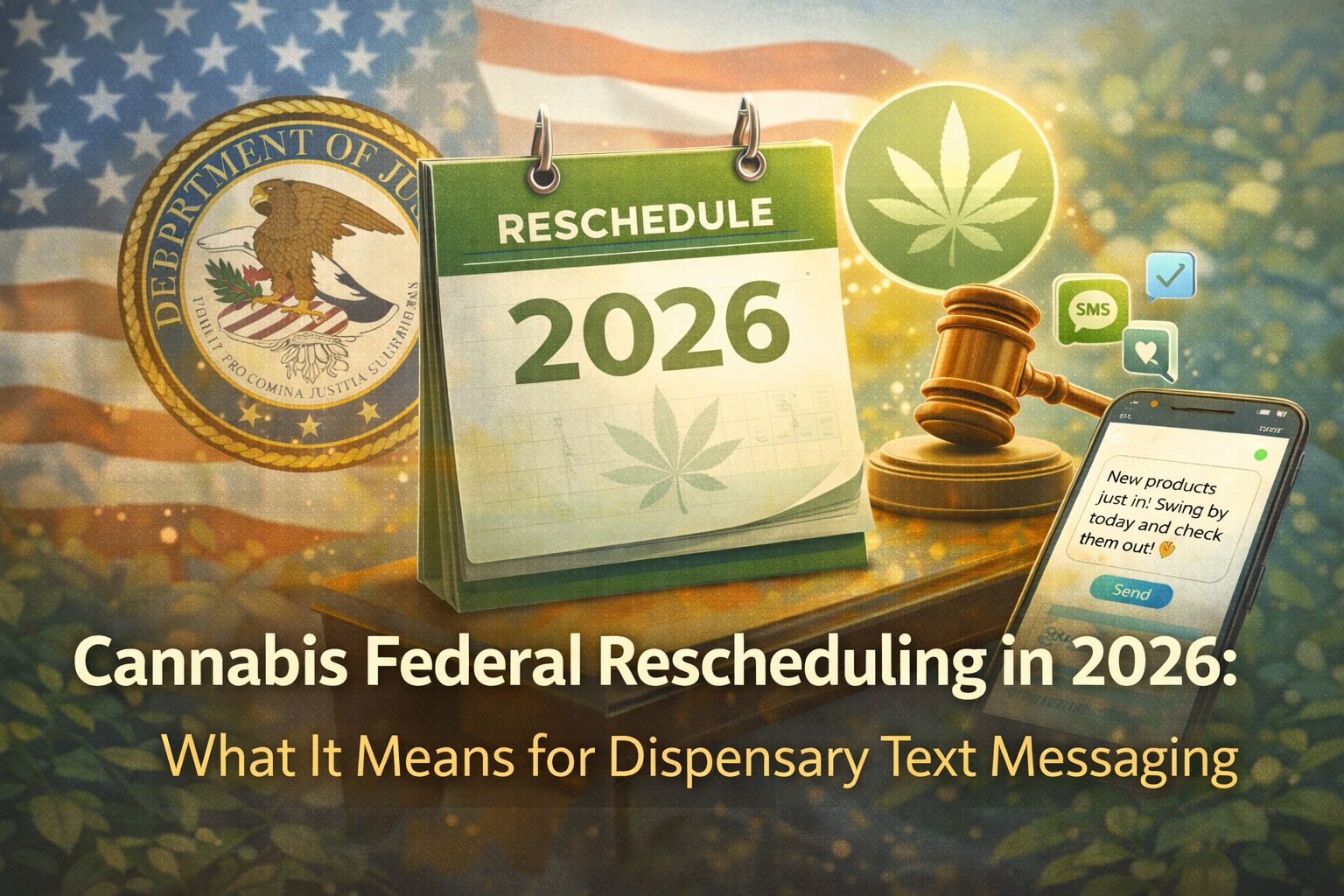
As discussions around cannabis federal rescheduling continue into 2026, many dispensary operators are asking the same question: what does this actually change for marketing and communication?
While rescheduling may impact taxation, research, and enforcement priorities, it does not automatically remove carrier rules, consumer protections, or messaging compliance requirements.
What Cannabis Federal Rescheduling Means
Federal rescheduling refers to changing how cannabis is classified under the Controlled Substances Act. This shift is often discussed in terms of medical research, banking access, and federal oversight.
Rescheduling is not the same as full legalization. Even under a new schedule, cannabis remains a regulated product with restrictions that affect advertising and communication.
What Rescheduling Does Not Change
One of the most common misconceptions is that rescheduling eliminates marketing and messaging restrictions. It does not.
Even with federal rescheduling:
- Wireless carriers still enforce their own content and consent rules
- Age restrictions remain in place
- Opt-in requirements for SMS do not change
- Spam filtering and enforcement continue
Carriers regulate text messaging independently of federal drug scheduling.
Why Carriers Still Control Dispensary Text Messaging
Text messaging in the United States is governed by carrier policies, not cannabis scheduling status.
Carriers evaluate messages based on:
- Consent and opt-in practices
- Message content and structure
- Sender reputation and behavior
- Consumer complaint signals
These systems do not change simply because federal classification changes.
How Rescheduling May Indirectly Affect Messaging Strategy
While the rules themselves may not change, operator behavior often does.
After regulatory shifts, dispensaries may:
- Increase messaging volume too quickly
- Assume promotional language is suddenly allowed
- Relax internal compliance checks
This is often when deliverability problems increase, not decrease.
Why Conservative Messaging Still Wins in 2026
Dispensaries that perform best after regulatory shifts are usually the ones that stay conservative in execution.
This includes:
- Keeping promotional content behind age-gated landing pages
- Using SMS for notifications, updates, and account value
- Maintaining consistent opt-in and consent flows
This approach protects deliverability regardless of regulatory headlines.
What Dispensaries Should Prepare for Now
Instead of waiting for clarity, dispensaries should focus on fundamentals that remain constant.
- Clean, well-documented opt-in flows
- Phone-number-based customer identity
- Clear separation between SMS and promotional content
- Visibility into message delivery and opt-outs
These foundations matter under any regulatory environment.
Why Messaging Infrastructure Matters More Than Ever
As the industry evolves, scrutiny does not disappear. It shifts.
Dispensaries that rely on messaging platforms built for regulated industries are better positioned to adapt without disruption.
This is why many operators focus on messaging systems that prioritize compliance, transparency, and control rather than chasing short-term opportunities.
Final Takeaway
Cannabis federal rescheduling in 2026 may change parts of the industry, but it does not remove the responsibilities that come with direct customer communication.
For dispensary text messaging, the fundamentals remain the same: clear consent, conservative execution, and reliable infrastructure.
Dispensaries that understand this avoid deliverability issues and stay ahead regardless of how federal policy evolves.